
# Moving Company Leads: How to Get Ones That Book

The moving company leads worth paying for are the ones that end in a signed estimate and a truck on the road. The most reliable way to get them is to own your demand: Google Ads and local search that put your company in front of people already searching for a mover, a call-tracking and CRM setup that shows which campaign produced which booked move, and a follow-up routine that answers fast. Roxfire Marketing Agency builds that system for local service businesses, including movers, and every campaign is tracked to revenue instead of clicks.
This guide explains what a qualified lead actually is, where movers get leads, how to set up Google Ads for moving, how to measure cost per booked move, and the rules that apply to calling and texting people who ask for a quote.
- A "lead" is any contact a channel hands you. A booked move is the only number that pays the bills, so measure every source by cost per booked move, not cost per lead.
- Bought leads are often sold to several movers at once, which turns the sale into a speed race. Leads from your own search ads, local listings and referrals reach you alone.
- Google Ads can start producing inquiries within days, while SEO and local search take months to build. Plan a real monthly ad budget and a longer-term local SEO effort together.
- Speed and structure convert leads: a fast first response, a short intake form, and a CRM that logs the source of each job.
- Texting and calling leads falls under federal consent rules, so confirm your process with a telecom or privacy attorney.
What a moving lead really is
People use "lead" for very different things, and the confusion costs movers money. There are four distinct events:
1. A form submission or inbound call. Someone raised a hand. It may be a real move, a price-shopper, a job seeker, a vendor or a duplicate. 2. An inquiry that fits your business. The person is in your service area, has a move date, wants a job type you do, and can be reached. 3. A qualified conversation. You confirmed the date, size of the home, access issues and whether the budget makes sense. 4. A booked move. A confirmed job on your schedule.
Write your own definition of "qualified" before you buy or run anything. A simple version for a local residential mover: the move is inside your service area, the date falls in a window you can staff, the size and services match what your crews handle, and you have a working phone number or email. Anything else is logged as unqualified with a reason, such as out of area, no move date, duplicate, or spam.
That reason code matters. After two months you can see whether a source sends mostly out-of-area requests (a targeting problem) or mostly people who never answer (a speed or follow-up problem). Those need different fixes.
Where moving company leads come from
Most movers use a mix of five sources. They differ in speed, cost and how much control you keep.
| Source | How fast it starts | What to watch |
|---|---|---|
| Google Ads (search) | Days | Needs a real budget and tight keyword and location control |
| Local SEO and Google Business Profile | Months | Slow to build, then steady and compounding |
| Referrals (realtors, storage and property managers, past customers) | Depends on relationships | Highest trust, but you cannot turn it up on demand |
| Purchased leads from marketplaces | Immediate | Often shared with other movers, so you compete on speed and price |
| Social ads (Meta: Facebook and Instagram) | Days | Reaches people before they search; works best for retargeting and local awareness |
Why owned demand beats bought leads
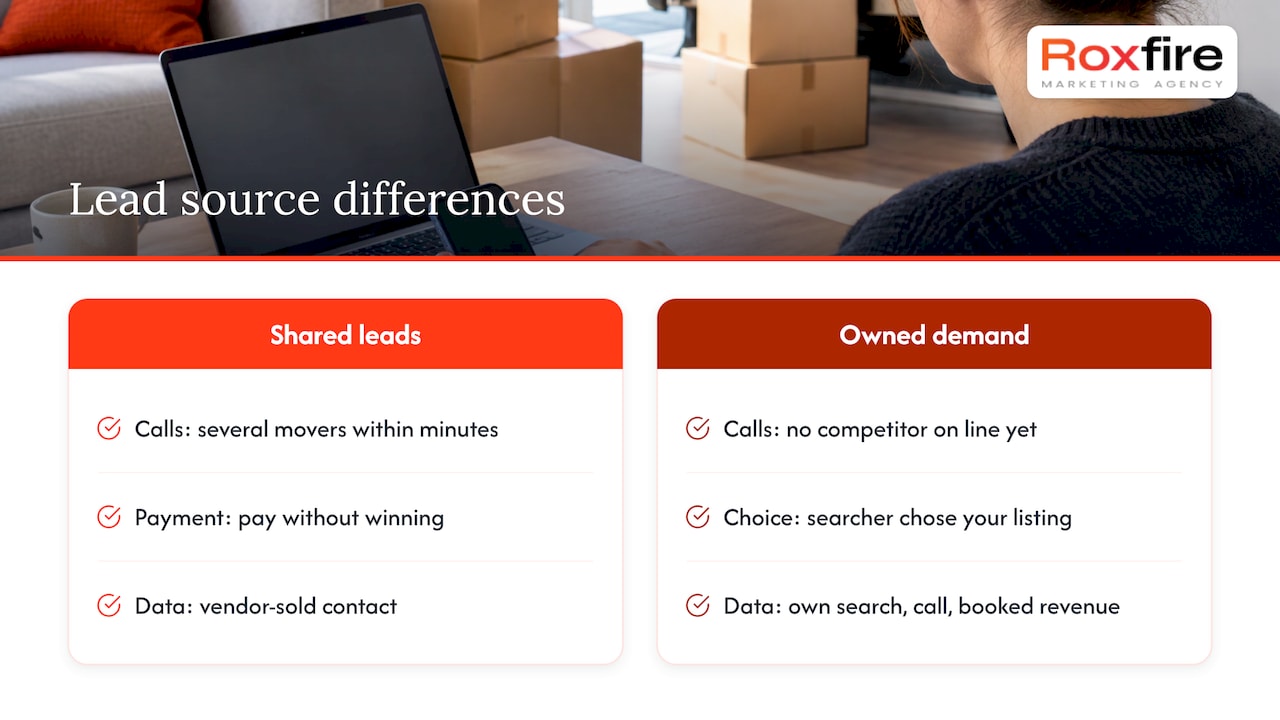
A purchased lead is a contact a vendor sold you. In the common shared model, the same person gets calls from several movers within minutes. You pay for the contact whether or not you win the job, and the first mover to quote often sets the price. Exclusive leads cost more per contact because only you receive them.
Owned demand works differently. When someone searches for movers in your city and clicks your ad or your Google listing, they chose you from the results. There is no competing caller on the line yet, and you own the data: the search term, the landing page, the call recording, and the booked revenue.
If you do test a purchased lead source, verify these before spending: whether leads are shared or exclusive, how duplicates and unreachable contacts are credited, what area and job type you can filter, and how the vendor defines "qualified" in writing. A contract that uses the word without defining the checks leaves you arguing over invoices later. Supplier screening, such as confirming a phone number is valid, is not the same as your own qualification, which confirms a move date and a realistic job.
Referrals and local relationships
Referrals usually close at the best rate for the least money, because the customer arrives already trusted. Build them on purpose: a short list of realtors, property managers, storage facilities and apartment communities in your service area, a one-page referral process they can use in two minutes, and a rule that referral requests go to your best estimator first. Thank every referrer, and track each partner by name in your CRM so you can see who actually sends booked moves.
Local visibility beyond search also helps a moving brand get recognized. If you want to think about localized advertising ideas such as vehicle-based outdoor ads in the neighborhoods you serve, treat them as awareness spending and give each campaign its own tracking number or QR code so you can see what it returns.
Google Ads for moving companies: how to set it up
Google Ads is the fastest controllable source because people searching "movers near me" or "local movers [city]" are usually weeks from a move. Here is how to set it up so the leads are worth answering. Our guide to Google Ads leads for local service businesses goes deeper on the account structure.
1. Choose intent keywords
Target phrases that signal a ready buyer: "movers near me," "local moving company," "apartment movers," "packing and moving services," plus your city names. Add negative keywords (terms you tell Google to never show ads for) such as "free," "cheap," "jobs," "hiring," "truck rental," "U-Haul style" rental terms and "DIY," so you stop paying for job seekers and do-it-yourselfers.
2. Split campaigns by service
Local residential moves, long-distance moves, commercial moves and packing-only jobs have different margins and different customers. Give each its own campaign and budget so a cheap-to-win job type does not eat the money for a more profitable one.
3. Control the geography
Set your location targeting to people in or searching for your service area, not just "interested in" it. Review which zip codes produce clicks with no inquiries, and cut those. A mover who covers one metro area should not pay for clicks 80 miles outside the crew's drive time.
4. Send clicks to a page built for one action
A dedicated landing page beats a homepage. It should show your service area, a phone number tap-to-call on mobile, a short quote form (name, phone, move date, origin and destination zip, home size), license and insurance details, and reviews. Short first, detailed later: ask for the full inventory during the estimate rather than demanding it up front. Roxfire builds these as landing pages for service businesses.
5. Track calls and forms to booked jobs
Most moving inquiries come by phone. Use call tracking numbers per campaign, form submissions tied to the search term, and conversion tracking set up through Google's own tools, so the account learns from real inquiries rather than clicks. Then close the loop: mark which inquiries became booked moves in your CRM and feed that back. Without that step you optimize toward cheap inquiries, which is how a campaign fills a calendar with tire-kickers.
6. Budget honestly
Ads need enough volume to learn. A tiny budget spread across several campaigns rarely gathers enough data to improve. Start with one or two campaigns on your most profitable job type, and expand when the cost per booked move is stable. Our breakdown of Google Ads cost per lead for home service businesses shows how cost ranges vary by trade.
Where Roxfire fits in the setup
Roxfire manages Google Ads for local service businesses, with management starting at $1,200 per month. Ad spend is paid directly to Google and is separate from that fee. We also set up conversion tracking and CRM automation so campaigns are measured against revenue, and there is no long-term contract. For the full moving-specific approach, see our moving company marketing page.
Local search: the slower channel that keeps paying
When someone searches "movers near me," Google often shows a map pack of three local businesses above or near the ads. Showing up there depends on your Google Business Profile (your free listing with reviews, hours and service area), consistent name, address and phone number across the web, local pages for each city you serve, and a steady flow of recent reviews.
Be realistic about the timeline. Local SEO builds over months, not weeks. A common plan is to run Google Ads for immediate inquiries while local SEO matures, then watch ad dependence drop as organic calls grow. Roxfire's local SEO and Google Business Profile work is built for that second phase.
Ask for reviews right after a successful move, while the crew's work is fresh. A text with a direct review link, sent the same day, gets more responses than an email a week later. Reply to every review, including the critical ones, in plain and courteous language.
Speed and structure: what turns inquiries into booked moves
Movers lose many jobs not because the lead was bad, but because nobody answered quickly. A person comparing three movers usually books with one of the first to respond with a clear next step.
Respond fast, including after hours
The common sales standard is to contact a new inquiry within five minutes. That is hard when estimators are at a customer's house or the office is closed. Options include an after-hours automated text reply, an AI voice assistant that answers calls and captures move details, and a rule that someone owns every new inquiry. Roxfire offers AI voice and automation along with email nurture campaigns so inquiries get an immediate reply and a follow-up sequence rather than silence.
Tier your inquiries
Not every inquiry deserves the same effort. A simple scoring system:
- Hot: move within a few weeks, inside your area, job type you do, answered the phone. Call right away and offer a same-day estimate.
- Warm: date is further out, or details are missing. Add to a follow-up sequence of texts, emails and a check-in call.
- Cold: vague date, no reply, or poor fit. Send an automated message and revisit later.
Keep the first form short
Ask for the minimum to start the conversation: name, phone, move date, and origin and destination. Gather inventory, stairs, elevators, parking and special items (pianos, safes) in a structured follow-up or video survey. Long forms lose people.
Put it in a CRM
A CRM (customer relationship management system) is software that logs every inquiry, who handled it, what was quoted and whether it booked. It lets you see where each job came from and sends automated reminders so quotes are not forgotten. Roxfire sets up Go High Level CRM and automation for service businesses, and our email nurture and follow-up systems keep estimates warm until the customer decides.
Know the rules before you call or text
Lead follow-up in the United States is regulated. The Federal Communications Commission (FCC) enforces the Telephone Consumer Protection Act, which governs autodialed and prerecorded calls and texts. The FCC's consumer policy page notes that it adopted a rule on December 13, 2023 aimed at the lead-generator robocall loophole, and that on July 14, 2025 it formally removed that one-to-one consent rule, reinstating the prior version of the rule.
In practice, keep these habits regardless of how the rules shift:
- Collect clear, written consent on your form for calls and texts, naming your company.
- Log the consent with a timestamp and the page where it was given.
- Honor opt-outs immediately.
- Check consent terms in any purchased-lead contract, since consent collected for another company may not cover you.
- If you use automated or AI-voiced calling, confirm with an attorney how consent applies to your specific setup before launch.
Rules change and state laws add requirements, so have a telecom or privacy attorney review your form language and follow-up scripts.
Measure cost per booked move, not cost per lead
A $40 inquiry that books half the time costs less per move than a $20 inquiry that almost never does. Use these formulas:
- Cost per booked move = total marketing spend divided by booked moves from that source.
- Return on ad spend (ROAS) = revenue from ads divided by ad spend.
Worked example with illustrative numbers: you spend $6,000 on Google Ads in a month and book 30 moves. Your cost per booked move is $200. If those moves brought in $27,000 of revenue, your ROAS is 4.5, meaning $4.50 earned per $1 spent. Look at both numbers together. A high ROAS can hide expensive bookings when only a few big jobs carry the month.
Include the full cost of acquisition for honest comparisons: ad spend, management fees, lead fees, software, and the estimator time spent on inquiries that never book. Record these on every job in your CRM:
- Source: Google Ads, map listing, referral partner, purchased lead, social ad.
- For ads: campaign, keyword and landing page.
- For purchased leads: vendor, lead ID, shared or exclusive, and the charge.
- For referrals: partner name and referral date.
Build a one-page monthly view of spend, inquiries, estimates, bookings and revenue by source. A simple campaign performance report layout in a spreadsheet is enough to show which channel earns its budget and which gets cut. Roxfire tracks campaigns to revenue, so the report reflects booked jobs and not just clicks.
A practical 90-day plan for a local mover
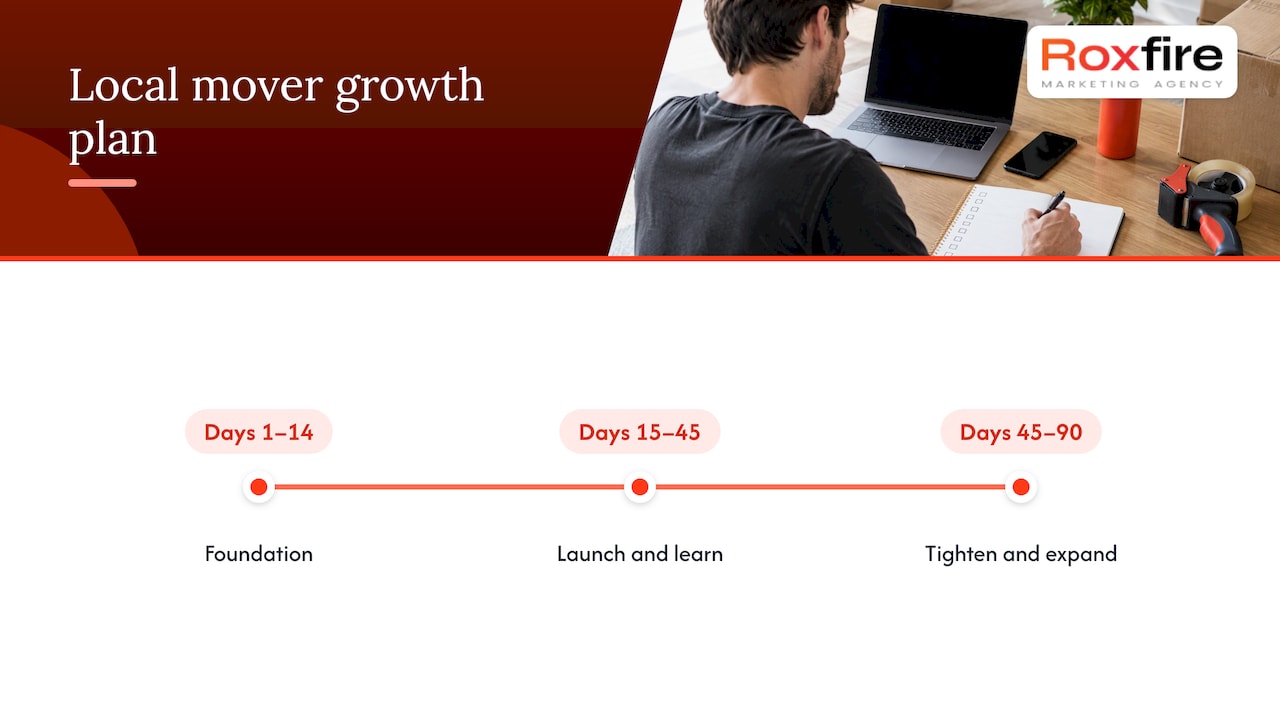
Days 1 to 14: foundation. Write your definition of a qualified inquiry. Clean up your Google Business Profile. Build a landing page with a short form and tap-to-call. Set up call tracking and conversion tracking, and connect a CRM.
Days 15 to 45: launch and learn. Start one Google Ads campaign for your best job type with intent keywords and negatives. Set an after-hours reply and a response rule. Review search terms weekly and add negatives. Ask for reviews after every completed move.
Days 45 to 90: tighten and expand. Cut zip codes and keywords that produce no booked moves. Add a second service campaign if the first is steady. Start referral outreach to realtors and property managers. Begin local pages and content for the cities you serve, which pays off later as SEO matures.
Results vary with market, season and competition, so no vendor can promise a number of leads. What you can control is whether every dollar is tracked to a booked move.
Work with Roxfire on moving leads
Roxfire is a performance marketing agency for local service businesses. For movers, that means Google Ads management starting at $1,200 per month, Meta Ads management starting at $940 per month, local SEO, landing pages, conversion tracking, CRM setup and automation, and AI voice and email follow-up. Ad spend is paid directly to the ad platforms and is separate from our management fees. There are no long-term contracts.


If your numbers do not add up, or you cannot say which source booked last month's moves, book a free marketing audit with Roxfire. We will look at your campaigns, tracking and follow-up. Start from roxfire.io, or see our Google Ads management and Meta Ads management pages.
FAQ
Are purchased moving leads worth it?
They can fill a gap quickly, but many are shared with several movers, so you pay for contacts you may not win. If you test them, confirm whether they are exclusive, how duplicates are credited, and track cost per booked move against your own search ads and referrals.
How much should a moving company spend on Google Ads?
There is no single right number. Start with enough budget for one or two focused campaigns to collect real data, then adjust based on cost per booked move. Our cost per lead guide shows how ranges differ by trade. Roxfire's management fee starts at $1,200 per month, and ad spend is paid directly to Google, separate from that fee.
How fast should I respond to a moving inquiry?
Aim for minutes, not hours. The widely used standard is within five minutes, and an automated text or AI voice reply can cover nights and weekends until a person follows up.
Can I text or call people who fill out my quote form?
Only with proper consent. Collect clear written consent on your form, keep a record, and honor opt-outs. Because federal and state rules change, have an attorney review your wording, as the FCC's consumer policy page tracks the federal side.
How long until Google Ads and SEO produce results?
Google Ads can generate inquiries within days of launch, though it takes weeks of tuning to improve cost per booked move. SEO and local search take months to build, which is why most movers run both.
Want this handled for you?
We run Google Ads, Meta Ads, and SEO for local service businesses. Book a call and we will show you what your numbers could look like.