# Landscaping Facebook Ads: How to Get Qualified Project Leads
Facebook ads can put your landscape design, install and maintenance work in front of homeowners in your service area, but they only pay off when the campaign is built around booked estimates and won jobs, not form fills. The ads themselves are the easy part. The hard part is the offer, the tight local targeting, the follow-up speed and the tracking that tells you which dollars produced revenue. At Roxfire Marketing Agency, we build Meta campaigns (Facebook and Instagram ads) for local service businesses, and the pattern is consistent: the contractors who do well treat ads as the top of a sales funnel, not as a stand-alone tool.
This guide walks through the full setup, step by step, with the places where campaigns usually go wrong. We never guarantee leads, and neither should anyone else. What you can control is how clean the setup is and how clearly you can read the results.
- Facebook works best for landscaping projects people did not know they wanted yet (patios, outdoor lighting, full redesigns), so lead with visual proof of finished work.
- Restrict targeting to the cities and ZIP codes you actually serve, and pick a campaign objective that matches the action you want, such as a lead form.
- Judge results by cost per booked estimate and cost per won job, not by cost per lead alone.
- Plan the budget backward from your close rate and average job size, and be realistic: ads need a real budget and a few weeks of data before you can optimize.
- Roxfire's Meta Ads management starts at $940/month, and ad spend is paid directly to Meta and is separate from that fee.
Why Facebook ads fit landscaping, and where they do not
Someone searching Google for "lawn mowing near me" already wants a mower. Someone scrolling Facebook is not shopping. Meta ads interrupt a scroll, which makes them a good fit when the project is visual and emotional: a new patio, a retaining wall, a pool surround, a full backyard redesign. A strong before-and-after image can plant the idea before the homeowner ever opens a search engine.
That also explains the limits. Facebook leads usually need more nurturing than a Google search lead, because the person was not actively looking. A lead who filled out a form on their phone between meetings may not remember doing it when you call three days later. Speed and a short, friendly first contact matter more here than on almost any other channel.
For urgent, high-intent work, such as storm cleanup or a broken irrigation line, search ads usually catch people at the moment of need. Many of our clients run both channels, and our Google Ads leads guide covers how local service businesses get qualified ones from search. For design-build, hardscape and seasonal maintenance contracts, Facebook and Instagram give you reach that search cannot.
Step 1: Choose the campaign objective and the goal
Meta asks you to pick a campaign objective before anything else, and that choice tells its system what kind of action to look for. A practical landscaping guide on Facebook advertising recommends matching the objective to the action you want, with a lead form as the example for collecting inquiries. For most landscapers the realistic options are:
- Leads (instant form): the homeowner submits their details without leaving Facebook. This is the lowest-friction option, and Meta describes lead ads with instant forms as a way to collect and qualify leads by asking people to fill out a form.
- Leads or sales (landing page): the homeowner clicks to your page and fills out a form there. It takes more effort from them, and usually produces fewer but better-informed inquiries.
- Calls or messages: useful for maintenance and quick quotes, as long as someone answers fast.
Where it goes wrong: owners choose "engagement" or "traffic" because the numbers look cheap. You then get likes and clicks from people who will never request an estimate. Pick the objective that matches the thing you want to see in your calendar.
One detail on a landing page: a dedicated page with one offer and one form converts better than your home page, which has menus that send visitors elsewhere. Roxfire builds landing pages for service businesses for this reason, so the click from the ad lands on a page designed around that single action.
Step 2: Build an offer that homeowners can say yes to
The most common mistake in landscaping ads is a generic message: "Quality lawn care, call today." Nothing in it gives a reason to act now or tells the homeowner what happens next. A better ad has three parts:
1. A specific service. Patio installation, spring cleanup, sod installation, drainage correction, outdoor lighting, a full design. 2. A low-friction next step. A free on-site estimate, a design consultation or a site walk. For high-ticket projects, a free consultation is a more honest ask than a coupon. 3. A local anchor. Name the town, the county or the neighborhood type. A lawn care advertising guide recommends restricting ads to the areas you are willing to serve and using local references in the offer and the copy.
Avoid discounts that attract the wrong jobs. A 20% off coupon on mulch brings people who want mulch only, not the $25,000 backyard. Match the offer to the project size you want more of.
Step 3: Show real work in the creative
Creative is the part owners can influence most, and it is where budgets are most often wasted. The same Aspire guide suggests image, video and carousel ads (multiple swipeable images in one ad) featuring project photos, transformations and testimonials. In practice that means:
- Before-and-after photos shot from the same angle, in good light, on a day when the site is clean.
- Short vertical video of a crew finishing a paver patio or a time-lapse of a lawn install. Phone video is fine if it is steady and the audio is clear or captioned.
- Carousels that walk through one project: the problem, the build, the finished result.
- Real customer reviews pulled from your own review profiles, used with permission.
Use photos of your own crews and your own projects. Stock photos of perfect lawns make ads look like every other ad, and homeowners can tell. If you hire a photographer or videographer for project shoots, read up on campaign usage fees first, because turning images into paid ads can carry licensing costs beyond the shoot itself.
Plan on refreshing creative regularly. When the same homeowners see one ad again and again, results fade, so keep a pipeline of new project photos coming in every week of the season.
Step 4: Target your actual service area
Landscaping is local and travel time is a real cost, so your targeting should mirror your route map. Meta lets you set locations by city, ZIP code or a radius around a point, and its guide to location targeting in Ads Manager explains how those options work. Aspire's guide recommends targeting serviceable cities, ZIP codes and neighborhoods, and researching local homeowner demand before choosing the audience.
A simple way to think about audiences, taken from a Power100 interview with a landscaping advertiser, is three approaches:
- Remarketing: show ads to people who already visited your website or engaged with your page.
- Broad targeting inside your service area: let Meta's system find likely buyers within the ZIP codes you picked.
- Custom or lookalike audiences: build them from your customer data, such as a list of past clients, so Meta can find similar people.
Where it goes wrong: a 25-mile radius that includes a county you do not serve, or a radius centered on your shop when your best jobs are in one affluent suburb on the other side of town. Review which ZIP codes your highest-value past jobs came from, and start there.
About tracking: we do not recommend installing third-party tracking pixels as a default step. Start with what Ads Manager and your CRM (the system where you store leads and job status) already give you, and add measurement only where a specific question needs it.
Step 5: Build the lead form to qualify, not just collect
The lead form decides whether your crew spends Tuesday quoting real jobs or chasing tire-kickers. A short form gets more submissions. A longer form gets better ones. The balance depends on how expensive your jobs are.
A lawn care guide from a social media scheduling company suggests a baseline form with first name, last name, email, phone number and one qualifying question about the service wanted. That is a sensible starting point. For landscape design and install work, we would add a question that screens for project size, such as a budget range or a timeline, because these separate a $400 cleanup from a $30,000 install.
Practical rules for the form:
- Ask what service they want, in a multiple-choice question.
- Ask for the property ZIP code, so you can filter out-of-area inquiries before anyone calls.
- Ask when they want the work done.
- Skip anything you will not use. Every extra field loses some people.
Then comes follow-up, which is where most Facebook leads are lost. Call or text within minutes, not hours. Roxfire's AI Voice and Automation service is built to help with this stage, and our CRM setup and automation work connects the ad, the form and the follow-up so every inquiry is logged and answered. Our article on how we use AI to improve lead quality covers the same idea for other trades.
Step 6: Set a budget from your numbers, not from a guess
The honest answer to "how much should I spend?" depends on your average job size, your close rate and how many estimates your crew can handle. Here is a method that works backward from the job.
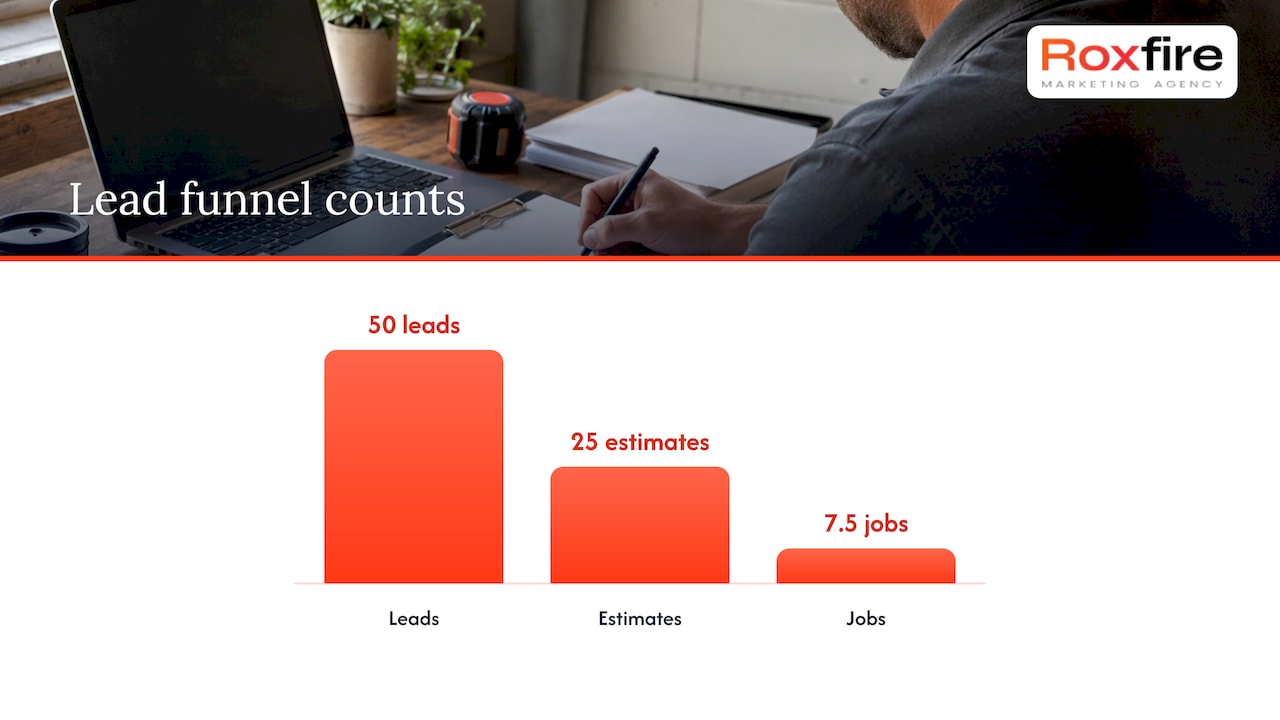
The Power100 interview suggests testing your budget against a funnel assumption of 50% of leads becoming in-person estimates and 30% of estimates becoming jobs. That is one practitioner's rule of thumb, not a universal benchmark, so replace it with your own rates as soon as you have data.
A hypothetical example, with every number invented to show the math:
| Step | Assumption | Result |
|---|---|---|
| Monthly ad spend | $3,000 | |
| Cost per lead | $60 | 50 leads |
| Leads that become estimates | 50% | 25 estimates |
| Estimates that close | 30% | 7.5 jobs |
| Ad cost per job | $3,000 / 7.5 | $400 |
Now compare $400 per job with the gross profit on an average job. If a typical install earns you $4,000 in gross profit, the ads look healthy. If it earns $500, you have almost nothing left after labor and overhead. Change the inputs to match your trade, whether that is maintenance contracts, lawn installs or hardscape.
Two timing points from experience. First, plan for a learning period: Meta's system needs a few weeks of results before you can judge a campaign, so cutting it after five days tells you very little. Second, budgets that are too thin cannot produce enough leads to learn from. If your monthly spend yields only a handful of leads, you cannot tell a weak ad from bad luck.
For reference, Roxfire's Meta Ads Management starts at $940/month. Ad spend is paid directly to Meta and is separate from our management fee, so you always control what goes to the platform.
Step 7: Measure what matters
Ads Manager reports click-through rate (the share of people who click after seeing the ad), cost per click, impressions, engagement, leads and conversions. Aspire's guide recommends comparing conversions against the campaign goal. These numbers help you diagnose the ad, but they are not the finish line.
The key shift is moving down the funnel. Track these in your CRM or even a spreadsheet:
1. Cost per lead: ad spend divided by form submissions. 2. Cost per qualified lead: spend divided by leads in your service area with a real project. 3. Cost per booked estimate: spend divided by estimates actually on the calendar. 4. Cost per won job: spend divided by signed contracts. 5. Revenue and gross profit per ad dollar: the number that decides whether to scale.
A low cost per lead can hide a bad campaign. If 40 leads become two estimates, you paid for 38 conversations that went nowhere. A higher cost per lead from a better-qualified form may be the cheaper path to a signed job.
Revenue is also not profit. Labor, materials, refunds and overhead still come out of the job, so judge the campaign on gross margin, not on contract totals alone. This is why every Roxfire campaign is tracked back to revenue rather than vanity metrics, and why we ask for lead outcomes from your CRM.
Common mistakes in landscaping Facebook ads
- Boosting posts. The Boost button is built for reach, not for qualified leads. Use Ads Manager with a real objective.
- Sending leads to a slow process. Leads that wait a day cool off. Set up instant notifications and a script for the first call.
- Running ads all year with one message. Spring cleanups, summer installs and fall leaf removal are different offers. Match creative to the season.
- Judging on weekly noise. One bad week in a small budget is not a trend. Review at least a few weeks of data together.
- Ignoring capacity. If your crew is booked for six weeks, advertise design consultations for next season or maintenance contracts, not rush jobs you cannot deliver.
Realistic timelines and tradeoffs
Paid social can produce inquiries within days of launching, but that is not the same as profit. Expect the first month to be a test: creative, audiences and forms get adjusted as data arrives. Landscaping is also seasonal, so budgets often move with the weather and your crew's capacity.
Paid ads and organic work serve different jobs. Ads rent attention while the budget runs, and local SEO (the work that helps you show up in Google Maps and local search results) builds slowly over months and keeps working in the background. If you want both, our local SEO service is the long-term companion to a Meta campaign.
How Roxfire runs Meta campaigns for local service businesses
Roxfire is a performance marketing agency for local service businesses, with no long-term contracts and flat-rate fees. Our Meta Ads Management covers Facebook and Instagram campaigns, from offer and creative direction to audience setup and conversion tracking. We also build the landing pages, CRM automation and follow-up that turn an ad click into a booked estimate, so the whole funnel is reviewed together instead of in pieces.
Meta Ads management starts at $940/month. Ad spend is paid directly to the ad platforms and is separate from our fee.

If you want a second set of eyes on your current campaigns, or a plan before you spend, book a free marketing audit with Roxfire. We will look at your offer, targeting, lead handling and tracking, and tell you where the gaps are.
Frequently asked questions
Do Facebook ads work for landscaping companies?
They can, especially for visual, higher-ticket projects such as patios, outdoor living spaces and full redesigns. Results depend on the offer, the creative, the speed of follow-up and a budget large enough to gather data. No agency can promise a specific number of leads, so judge any campaign by booked estimates and won jobs.
How should I target homeowners for landscaping ads?
Start with the cities and ZIP codes you actually serve, using Ads Manager's location options. Then add remarketing to your website visitors and, once you have customer data, a lookalike audience built from past clients. Review which neighborhoods produced your best jobs and weight your targeting toward them.
What should a landscaping lead form ask?
Name, phone, email, ZIP code and the service wanted make a solid base. Add a project timeline or budget range for larger installs to screen out small inquiries. Keep it short enough that people finish it on a phone.
How do I know whether my Facebook ads are profitable?
Track cost per booked estimate and cost per won job, then compare that cost with the gross profit on the job. Cost per lead alone can mislead you, because cheap leads that never close are expensive. Pull the outcomes from your CRM at least monthly.
Should I run Facebook ads or Google Ads?
They do different work. Google Ads catches people already searching for a service, while Facebook and Instagram create demand for projects people have not started planning. Many local service businesses run both, and Roxfire manages Google Ads and Meta campaigns together so the results can be compared on the same revenue numbers.
Want this handled for you?
We run Google Ads, Meta Ads, and SEO for local service businesses. Book a call and we will show you what your numbers could look like.