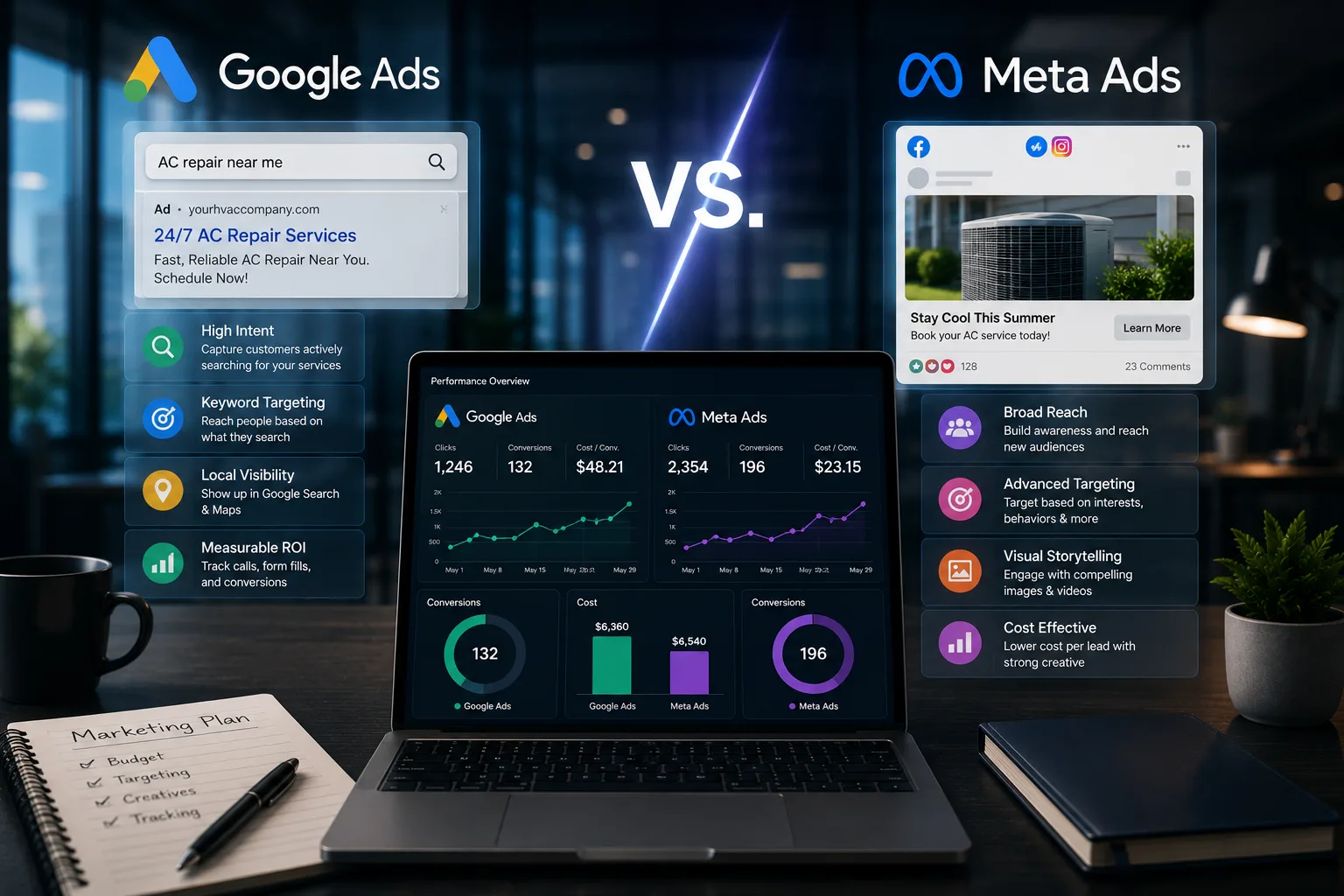
When it comes to paid ads, you've got two main players: Google Ads and Meta Ads. Both can get you in front of the right people, but they work in totally different ways. Google is all about search intent—grabbing people who are actively looking for what you sell. Meta, on the other hand, is a master of audience targeting, using its social media muscle to find people based on who they are and what they're into. Look, figuring out where these two platforms shine isn't just a nice-to-know. It's everything if you want to spend your marketing dollars wisely and actually see a return. In this guide, we'll break down the real differences, data and all, to help you decide which one makes sense for your business and how to use them together to really own your market.
The Power of Intent: Google Ads' Core Strength
Here's the thing about Google Ads: its magic is in capturing people at the exact moment they need something. That's search intent. Someone searches for 'emergency plumber near me' or 'best CRM for small business'—they're not just browsing; they have a problem that needs solving, right now. By bidding on those keywords, you put your business right in their path. That's why it's so powerful for getting leads and making sales. And with Google handling over 8.5 billion searches a day, the scale is just massive. If you're a service business that fixes urgent problems, you can't beat it. To win, you need to nail your keyword research and write ad copy that speaks directly to what they searched for, making your business the obvious answer.
Mastering the Audience: Meta Ads' Targeting Prowess
While Google Ads finds people who are already looking, Meta Ads is all about creating the demand in the first place. Its superpower is its ridiculously detailed audience targeting. Think about it: with over 3 billion people on Facebook and Instagram, Meta knows a *lot* about what people like, who they are, and what they do online. This lets you build super-specific audiences. A local yoga studio, for instance, can target women aged 25-40 in a 10-mile radius who are into wellness and mindfulness. Because it's so visual, with a focus on images and video, it's perfect for showing off products and telling a story. It works incredibly well for e-commerce, local spots, and any brand that needs to build some buzz. You're basically reaching people who didn't even know they wanted your stuff yet.
A Tale of Two Budgets: Cost Comparison
So, which one costs more? That's not really the right question. It's about where you get more value. On Google Ads, you'll often pay a higher cost-per-click (CPC), especially for those hot, ready-to-buy keywords. You're paying a premium to get in front of people who are actively shopping. But that higher cost usually pays off with more conversions, giving you a solid return on ad spend (ROAS). Meta Ads, on the other hand, usually has a lower CPC and cost-per-mille (CPM). You can reach more people for less money, but the catch is that this audience is 'colder'—they're not as far along in their buying journey. Your costs on Meta will also swing depending on who you're targeting, your industry, and how good your ads are. If you're working with a smaller budget, Meta can be a great starting point. But if you need high-value leads, that higher CPC on Google is often money well spent.
Platform cost per click matters less than what a converted lead ends up costing. Our cost per lead benchmarks for home services show how far real accounts sit from published averages.
Finding Your Fit: Industry-Specific Recommendations
Service businesses that solve an immediate problem—plumbers, lawyers, HVAC pros—absolutely kill it on Google Ads. Getting in front of those high-intent searches is a direct line to paying customers. B2B companies also use Google Ads to get in front of decision-makers who are researching solutions. On the flip side, e-commerce brands, fashion lines, and food and beverage companies often get amazing results from Meta Ads. The visual-first vibe is perfect for making products look irresistible and creating brand desire. Local businesses like restaurants, gyms, and shops can also use Meta's powerful local targeting to get people in the door. The bottom line: match the platform to your customer. If they're searching for you, start with Google. If you need to get on their radar, go with Meta.
Strategic Implementation: When to Use Each Platform
To get the most out of Google and Meta, you have to know where they fit in your marketing funnel. Use Google Ads for the bottom of the funnel (BOFU). This is where you cash in on demand from people who are ready to pull the trigger. Your campaigns should be laser-focused on high-conversion keywords, sending people to landing pages built for one thing: getting them to act, whether that's filling out a form or buying something. Use Meta Ads for the top (TOFU) and middle (MOFU) of the funnel. At the top, you run brand awareness campaigns to introduce yourself to new people. In the middle, you use retargeting to stay in front of people who've already checked you out, hitting them with more specific messages and offers. For example, you can retarget people who visited your website or engaged with your Instagram. When you use each platform for what it's best at, you build a complete system that moves people from just hearing about you to becoming a customer.
The Power Couple: Combining Google and Meta Ads
Comparing Google and Meta is one thing, but the real magic happens when you use them together. This one-two punch lets you cover the entire customer journey. You can use Meta Ads to build awareness and get people interested, filling the top of your funnel. Once they know who you are, they might start searching for you on Google. And that's when your Google Ads campaigns swoop in to capture that demand you just created. Here’s a classic play: run a video ad campaign on Instagram showing off a new product. Then, you can retarget everyone who watched most of the video with more specific ads. At the same time, you run a Google search campaign for keywords related to that product. That way, when they're finally ready to buy, you're right there. It's a flywheel—each platform makes the other one stronger.
Smart Spending: A Practical Budget Allocation Strategy
There's no magic formula for splitting your budget between Google and Meta. It has to be driven by data. A decent starting point for a lot of businesses is a 70/30 split: 70% goes to the platform that aligns with your main goal (like Google for a law firm or Meta for a clothing brand), and 30% goes to the other for retargeting and awareness. But that's just a starting line. The right mix depends on your numbers. Keep a close eye on your key performance indicators (KPIs) for each platform—cost per lead, cost per acquisition (CPA), and ROAS. If you see Google is bringing in leads for way cheaper, it's a no-brainer to send more money that way. If a Meta campaign is crushing it with brand awareness, maybe you feed it more budget. The key is to be nimble. Check your performance every week and don't be afraid to move your money based on what the data tells you. That's how you make sure you're always getting the best possible ROI.
Before shifting budget between platforms, it is worth checking whether the landing page is the real constraint - improving your conversion rate often lowers acquisition cost without touching spend. Roxfire manages both channels: Google Ads and Meta Ads.
Ready to Grow Your Business?
Let our team of experts build a data-driven advertising strategy that delivers real results. Schedule a free consultation today to find out how Roxfire can help you achieve your goals.