# HVAC Local SEO: How to Get Found in Your Service Area
HVAC local SEO is the work of making your company show up on Google when someone nearby searches for AC repair or furnace installation. It covers your Google Business Profile, your website, your reviews and the links that point to you. It also has to be tracked all the way to booked jobs, not just rankings. At Roxfire Marketing Agency (Roxfire), we build local SEO around that last part: a lead only counts once it turns into revenue.
- Local SEO puts you in two places: the Google map results at the top (the "local pack") and the regular organic listings below. Each catches a different customer.
- Google ranks local results mainly on relevance, distance and prominence, and you cannot pay for a better local ranking.
- Service-area rules matter: up to 20 areas, set by city or postal code, within roughly two hours' drive of your base.
- Measure calls, booked jobs and lead quality, not just rankings. A CRM (customer relationship management software) makes that possible.
- SEO takes months to build. Paid ads can fill the gap, but they need a real budget.
What local SEO means for an HVAC company
Search engine optimization (SEO) is the practice of improving your online presence so Google shows it for relevant searches. Local SEO narrows that to searches tied to a place. Jobber's HVAC SEO guide describes it as appearing in the local pack, map results and organic listings for searches like "AC repair near me." An HVAC customer whose system just quit wants someone nearby, available and credible. If you are not visible at that moment, they call whoever is.
There are two places to win:
- The local pack and maps. Three local businesses sit at the top, aimed at people ready to call now.
- Organic results. These catch people comparing options, researching costs, or searching from neighboring cities, as Applause explains.
A company that targets both reaches the emergency caller and the homeowner planning a replacement next spring.
How Google decides who ranks locally
Google's own help page says local results rely mainly on three things:
1. Relevance: how well your profile matches what the person searched. 2. Distance: how far you are from the searcher or the area named in the search. 3. Prominence: how well known you are, including reviews and the number of websites linking to you.
The same page says there is no way to request or pay for a better local ranking. That is why local SEO is slow work: you earn the signals one at a time.
Distance has a practical consequence. A homeowner 20 miles from your address may not see you in map results even with the best reviews, a point Applause makes. Organic pages built for the outlying towns you serve are how you reach them.
Set up your Google Business Profile for a service area
Your Google Business Profile is the free listing that shows your hours, phone number, website and service area. Google's Business Profile page confirms you can define your service area even without a storefront.
The rules that trip up HVAC companies:
- Hide the address if you do not serve customers there. Google says service-area businesses can hide the address and list their service area instead.
- Up to 20 service areas. They are set by city, postal code or similar area, not a radius, and the whole area should stay within about two hours' driving time of where you are based, per Google's service-area help page.
- Do not list states or countries. Google added an explicit rule in June 2025, reported by Search Engine Roundtable.
- One profile per central office. Google's representation guidelines bar virtual offices unless they are staffed during business hours. Separate locations with their own staff and service areas may each have a profile.
Be specific. Listing the 12 towns you actually run trucks to beats listing 20 you hope to reach. Keep your name, address and phone number (NAP) identical on your website, profile and directories, since mismatches weaken trust in your listing.
Google's 2026 Business Profile playbook for services also asks for specific, accurate service areas, which is the standard to build to.
Build pages for the areas you serve
Your profile gets you into the map results. Your website has to back it up. A strong HVAC site usually has:
- One page per core service: AC repair, furnace repair, installation, maintenance plans.
- One page per major city or neighborhood group you serve, with real details: the local housing stock, common failures in your climate, and jobs you have done there.
- Clear phone numbers and a short booking form on every page.
- Fast loading on a phone, because most emergency searches happen on one.
Avoid thin pages that swap only the city name. They add little and read as filler. Our on-page SEO service and website optimization work cover this structure, and dedicated landing pages help when a page needs to convert paid traffic too.
Reviews, citations and local backlinks
Prominence is where most HVAC companies fall behind, and it is built from three things.
Reviews. ACHR News notes that a top-three map placement on an urgent search is a high-value moment, and it converts to calls when your review count and rating beat your competitors'. Ask every customer after the job, while the technician's visit is fresh, and reply to every review. BrightLocal's 2026 survey, cited by SEO Timer, found 97% of consumers read reviews for local businesses and 54% visit the website after reading positive ones.
Citations. A citation is a mention of your name, address and phone number on another site, such as a directory. Consistency matters more than volume. Fix mismatches first, then add the major directories and the trade-specific ones.
Backlinks. A backlink is a link from another website to yours. Google lists the number of sites linking to you as part of prominence. Local sources tend to be the most relevant:
- Your chamber of commerce and local business associations.
- Sponsorships of youth teams or community events that publish sponsor pages.
- Manufacturer and utility rebate pages that list certified installers.
- Local news coverage of a community project or a seasonal tune-up tip.
Avoid bought link packages. They are cheap for a reason, and a profile with unnatural links can lose ground instead of gaining it. Link building is a service we offer, built around sources a real local contractor would earn.
Use a CRM to catch and follow up on every lead
Rankings produce calls and form fills. A CRM turns them into booked jobs. A CRM is software that records each lead, where it came from and what happened next. For an HVAC shop it should do at least this:
- Log every call and form submission with its source (map listing, organic search, ads).
- Send an instant text or email reply when a form comes in after hours.
- Remind your office to follow up on estimates that have gone quiet.
- Record whether the lead became a job and what it was worth.
Without that last item, you cannot tell whether SEO is paying for itself. Roxfire sets up Go High Level CRM and email nurture campaigns, and offers AI voice and automation so after-hours calls are answered instead of lost. Details are on our marketing services page.
Measure what matters
A report that shows only keyword rankings can look good while the phone stays quiet. Track these in order of importance:
1. Booked jobs and revenue by source. From your CRM. 2. Qualified calls and form fills. Calls that were real service or install requests, not wrong numbers or job seekers. 3. Profile actions. Calls, direction requests and website clicks from your Google Business Profile. 4. Visibility. Where you appear in the map results and organic listings for your core services in each service area. 5. Lead quality. The share of leads that are in your service area and match the jobs you want.
We track campaigns to revenue rather than to vanity metrics. A standard setup relies on call tracking and conversion tracking tied to your CRM. We do not treat installing extra third-party tracking pixels as a default step.
What to expect: timelines and costs
Local SEO is a build, not a switch. Profile fixes and review habits can help within weeks, but rankings in competitive markets usually take months of consistent work. No one can promise a specific number of leads, and we do not.
Because of that, many HVAC companies run paid search alongside SEO. Ads can bring calls while organic rankings grow, but they need a real budget. Our guides on HVAC Google Ads and HVAC lead generation cost go through the numbers.
What to look for in HVAC SEO services
Whether you hire an agency or build a team, check these points:
- Trade focus. Do they understand seasonal demand, emergency calls and service-area limits?
- Reporting tied to jobs. Ask what they report beyond rankings.
- Your ownership. The profile, website and analytics accounts should be in your name.
- Contract terms. Roxfire has no long-term contract obligation.
- Clear scope. You should know what the monthly fee covers.
How Roxfire approaches HVAC local SEO
Roxfire is a performance marketing agency for local service businesses, HVAC included. Our local SEO and Google Business Profile service handles the profile, local pages, citations and links, and connects results to your CRM. Published SEO plans are:
| Plan | Monthly fee |
|---|---|
| Local Growth | $1,000-$1,500 |
| Revenue Engine | $2,000-$3,000 |
| Market Domination | $4,000-$6,000 |
See the SEO packages for what each includes. For paid search, Google Ads management starts at $1,200/month and Meta Ads management at $940/month. Ad spend is paid directly to the ad platforms and is separate from our fee. HVAC-specific plans are on our HVAC packages page, and our HVAC marketing page shows the full approach.

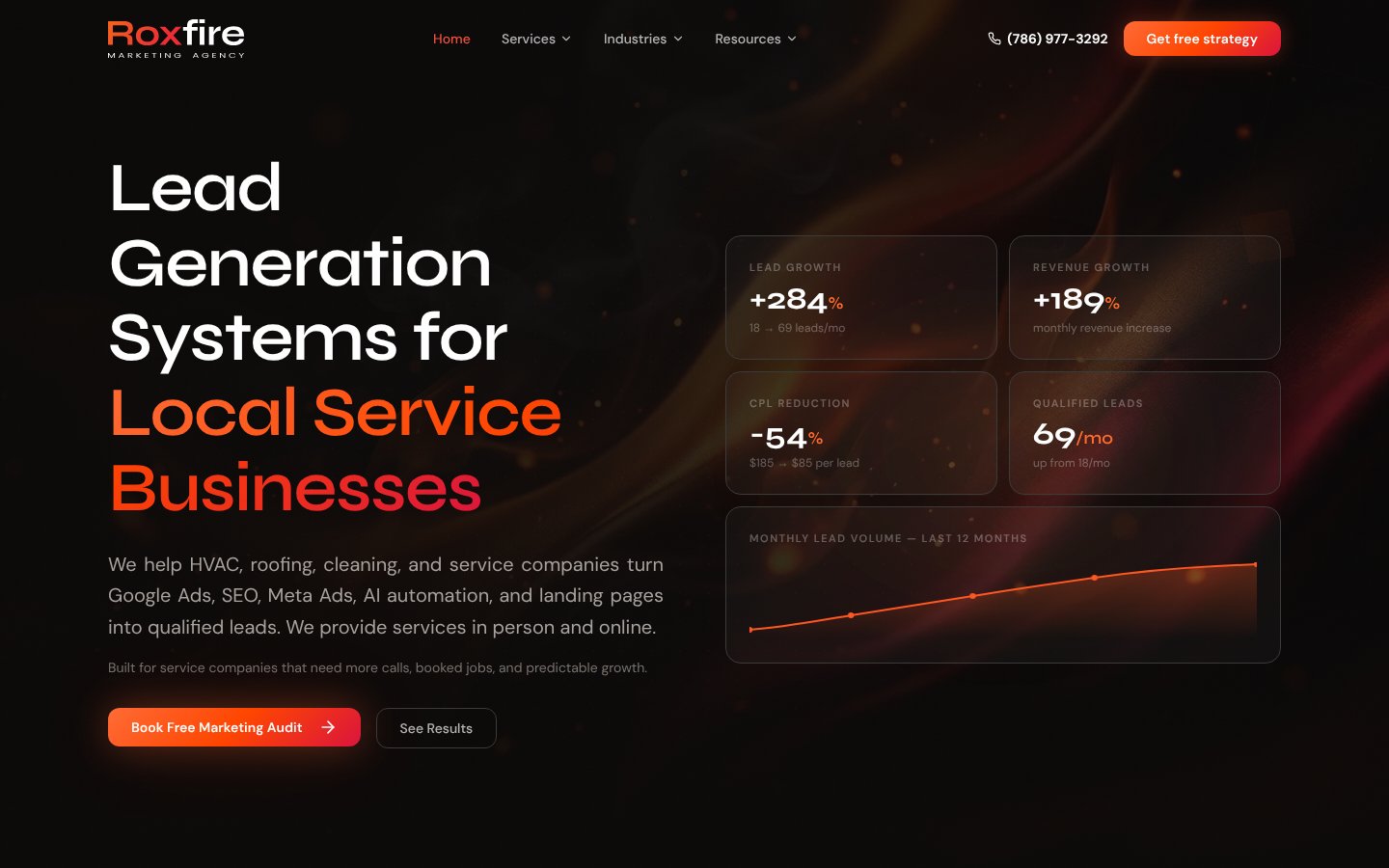
Book a free marketing audit and we will review your Google Business Profile, service areas, reviews and lead tracking.
FAQ
How long does HVAC local SEO take to work?
Profile cleanup and review requests can show effects within weeks, but competitive rankings typically take several months of steady work. Results depend on your market and competitors, so no one can honestly guarantee a lead count.
Can I rank in cities where I have no office?
Yes, to a degree. You can list up to 20 service areas, and organic pages for those towns can rank. Map results favor businesses closer to the searcher, so distant towns are harder.
Do I need a physical address on my profile?
Not if you serve customers at their homes. Google lets service-area businesses hide the address and show a service area instead.
What should I track to know SEO is working?
Track booked jobs and revenue by source first, then qualified calls, profile actions and map visibility. A CRM connects the leads to the jobs.
Sources
- SEO for HVAC Companies: 15 Tips (Jobber)
- How to Improve Local SEO for HVAC Companies (Applause)
- Tips to improve your local ranking on Google
- Google Business Profile for businesses in the US
- Manage your business address - Google Business Profile Help
- Manage your service areas - Google Business Profile Help
- Guidelines for representing your business on Google
- Google Updates Service Area Business Guidelines (Search Engine Roundtable)
- Google Business Profile Best Practices Playbook 2026
- Why Local SEO is Crucial for HVAC Companies (ACHR News)
- Local SEO for HVAC (SEO Timer)
Want this handled for you?
We run Google Ads, Meta Ads, and SEO for local service businesses. Book a call and we will show you what your numbers could look like.