# HVAC Facebook Ads: How to Run Them and What They Cost
Facebook and Instagram ads can fill an HVAC schedule, but only when four things line up: one clear offer, a tight service area, a fast follow-up routine and tracking that reaches past the lead to the sold job. Most failed campaigns break at one of those four, not at the ad itself. At Roxfire Marketing Agency, we run Meta Ads (Meta is the company behind Facebook and Instagram) for local service businesses, and this guide walks through the whole routine as we would explain it to an HVAC owner.
No ad channel can promise a set number of leads, and this one cannot either. What you can control is the setup, the budget discipline and what you measure. That is what the rest of this page covers.
- Facebook ads reach homeowners before they search, so they suit tune-ups, maintenance plans and replacement conversations. Google ads catch people who already have a problem. Most HVAC companies need both over a year.
- Set the campaign objective to lead generation, keep the radius to the area your crews actually cover, and lead with one specific offer.
- Cost per lead is only a starting number. The number that pays your bills is cost per booked visit and cost per sold job.
- Speed to call decides results. A lead that waits until tomorrow has often already talked to another shop.
- Plan for a real budget and a testing period. Judge a campaign on weeks of data, not on two days.
What Facebook ads do for an HVAC company
A search ad answers a homeowner who typed "AC not cooling." A Facebook or Instagram ad appears while someone scrolls, so it has to give them a reason to act on something they were not thinking about a minute ago. That difference shapes everything about how you run HVAC social media ads.
It makes Facebook a good fit for jobs where the homeowner can act on a schedule rather than in an emergency:
- Seasonal tune-ups. A spring AC check or a fall furnace check is easy to say yes to.
- Maintenance plans. A recurring plan is a natural offer for people who have not had a system looked at in years.
- Replacement estimates. An aging system with rising repair bills is a project people postpone. A clear, no-pressure estimate offer gives them a reason to move.
- Financing messages. Many replacement jobs depend on monthly payments, and an ad can raise that early.
It is a weaker fit for no-cool or no-heat emergencies. Those homeowners search, and a Google Ads campaign built for HVAC is the better tool for them. Our HVAC marketing playbook covers how the two channels fit together.
Pick the offer before you touch Ads Manager
The offer does more work than the targeting. A homeowner needs to see, in a second, what they get and why now. Trade press agrees on the starting point: HVACR Business describes a low-priced tune-up special as the best evergreen offer, especially in shoulder seasons, when demand between summer and winter is slow. It works best framed around what a homeowner risks by skipping it.
A good HVAC offer has these traits:
1. One service. "Furnace tune-up" beats "heating, cooling and air quality services." 2. A visible price or clear value. If you charge for the visit, say so. Vague offers attract vague leads. 3. A reason that fits the season. Pre-winter furnace checks in October, AC checks before the first hot week. 4. Something your crew can deliver this week. Do not advertise a special you cannot staff.
If you want replacement jobs, do not advertise "free quotes" to everyone. Name the situation: a system over a certain age, repeated repairs, or a rising energy bill. The more specific the situation, the fewer tire-kickers fill the form.
Set up the campaign step by step
Here is the setup in the order we would build it. Each step lists where it usually goes wrong.
1. Choose the lead generation objective
Meta optimizes toward whatever objective you pick. HVACR Business notes that telling Meta you want website traffic instead of leads means you will struggle to get leads. For a first campaign, choose the leads objective with an instant form. Meta describes lead ads with instant forms as a way to generate and qualify leads by having people fill out a form inside the app.
Where it goes wrong: picking "traffic" because it shows a cheaper click. A cheap click from someone who never submits anything is not a bargain.
2. Draw the service area honestly
Set the location to people who live in the area, using a radius around your shop or the cities your crews cover. Do not stretch it to look bigger. If a technician cannot reach a lead within your normal drive time, that lead costs you money twice: once for the ad and once for the awkward call.
Good geographic targeting is mostly about cutting waste. This guide on geo targeting ads covers the budget side of that choice. For HVAC, the practical rule is to start with your core service area, watch where booked jobs come from, then widen only if the numbers support it.
Where it goes wrong: one huge radius that mixes your best neighborhoods with far-out ZIP codes you do not want to serve.
3. Keep the audience broad and let the offer filter
HVAC is a need nearly every household has at some point, so heavy interest stacking rarely helps. A common starting approach is a broad audience within your radius, with the ad copy and offer doing the filtering. Narrow later based on which leads actually book.
Where it goes wrong: layering ten interests and shrinking the audience until the same people see the ad again and again.
4. Build a short form
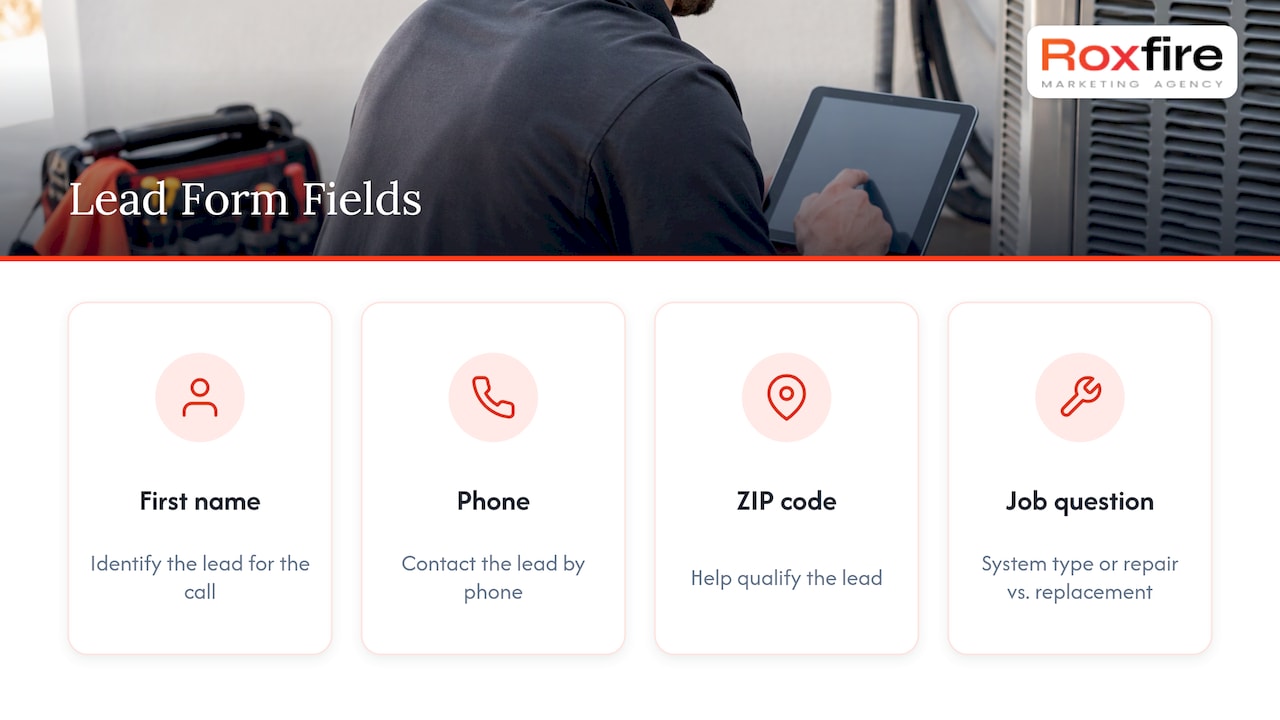
Ask for what you need to call and qualify: first name, phone, ZIP code and one question tied to the job (system type, or whether the issue is repair or replacement). Every extra field loses some people. Add a thank-you screen that tells them when you will call.
Where it goes wrong: a long form that looks like an insurance application, or a thank-you screen that promises nothing so the lead forgets they filled it out.
5. Write the ad around one picture and one promise
Use a real photo of your own crew, truck or install rather than a stock image. Put the offer in the headline and the price or terms in the primary text. Keep the call to action matched to the form.
6. Set a budget you can hold
Pick a daily budget you can keep running without changes for at least a couple of weeks. Ad platforms need data to learn who responds, and constant edits reset that. Service Nation suggests budgeting for a full 30 days and letting each campaign run 7 to 10 days before judging it. Treat that as a reasonable minimum. That is also why paid ads need a real budget: a few dollars a day cannot generate enough data to tell you anything.
Where it goes wrong: pausing after two slow days, or doubling the budget after one good day.
7. Call every lead the same day
This step belongs in the setup because it is where most of the budget is won or lost. We cover it in its own section below.
Creative that fits the feed
People scroll Facebook and Instagram to see friends, news and entertainment. An ad that looks like a flyer gets skipped. HVACR Business argues that content should feel relatable and scroll-stopping, and that the rule of thumb is whether it would be worth watching even without paid promotion. Branded graphics that carry only an offer, the same article says, cost far more per lead.
Ideas that fit HVAC:
- A short video of a technician explaining what a tune-up actually checks, in plain words, filmed on a phone.
- Before-and-after photos of a clean coil, a swapped filter or a finished install.
- A seasonal, relatable hook, such as the first cold morning when the furnace does not kick on.
- A customer story told by the customer, with their permission.
When you shoot video, add captions. Many people watch with the sound off, so a clip that only works with audio loses them. For more on building a narrative into an ad, this piece on visual storytelling in advertising covers techniques that carry over to a short service clip.
Rotate fresh creative every few weeks. When the same person sees the same ad too often, results tend to decline, so watch the frequency number (how many times the average person has seen your ad) in Ads Manager.
What Facebook ads cost for HVAC
There is no single price. Cost depends on your market, your offer, the season, your creative and how fast you follow up. The public benchmarks give a frame:
| Benchmark | Figure | Period and source |
|---|---|---|
| Average cost per click, Meta leads campaigns | about $1.92 | WordStream, published Oct 2025 |
| Average cost per lead, all industries | $27.66 | WordStream, published Oct 2025 |
| Average cost per lead, Home & Home Improvement | $41.26 | WordStream, published Oct 2025 |
These are averages across many advertisers, published for one period. They move with competition and season, so use them as a rough frame and not a promise of what you will pay. Home improvement sits above the all-industry average, which fits what we see in the logic of the work: the jobs are large, the buyer is cautious and the service area is small.
Two more points about cost:
- Cost per lead is not cost per job. A $40 lead that books and buys a $9,000 system is cheap. A $15 lead that never answers the phone is expensive. Our guide to HVAC lead generation cost walks through how to work backward from the job value.
- Cost per 1,000 views is not the metric to manage. It is called CPM (cost per thousand impressions), and it only tells you what Meta charges to show the ad. It matters because a high CPM can raise your cost per lead, but you manage the campaign by what happens after the form is filled.
A simple worked example. Suppose you spend $2,000 in a month and get 50 leads. That is $40 per lead. You reach 30 of them by phone, book 15 visits and sell 4 jobs. Your cost per booked visit is about $133 and your cost per sold job is $500. Whether $500 is good depends on your average ticket and margin. If the same $2,000 had produced 80 cheaper leads but only 2 sold jobs, the cheaper lead count would have hidden a worse result. (This example uses made-up round numbers to show the math, not results from any company.)
Follow-up decides the result
A homeowner who fills in a form at 8 p.m. is often comparing shops that same evening. If your first call comes after lunch the next day, you are the second or third shop to reach them. A few habits fix most of this:
- Assign one person to new leads and make that their first task each morning and evening.
- Send an instant text that confirms the request and says when you will call.
- Call again, at a different time of day, if there is no answer, then follow up with a text.
- Mark the outcome of every lead: no answer, not a fit, booked, sold.
Missed calls are the weak point for small crews who are on roofs and in attics all day. That is where our AI voice and automation work fits: it can pick up, ask the basic questions and book visits so a lead does not wait for a callback. See AI Voice and Phone Automation for what we build there. Our CRM setup, on the Go High Level platform, keeps each lead and its status in one place. For a broader look at how automation helps with this, read this guide to lead generation automation.
Track to revenue, not to likes
An ad report that stops at clicks and leads cannot tell you which campaign pays. The routine that works, weekly:
1. Count leads from each campaign. 2. Count how many were reached and how many booked a visit. 3. Count how many sold, and the revenue. 4. Divide spend by each count to get cost per lead, per booked visit and per sold job.
This takes discipline more than software. The key is that your CRM or job system records where each lead came from, so a sold job can be tied back to the ad. We do not suggest adding third-party tracking tools as a default. Start with the lead source captured in the form and in your CRM, and add more only when a specific question needs it.
Be realistic about attribution. Facebook ads often influence a homeowner who calls later or searches your name on Google. Some of that value will not show up in the ad report. Looking at booked jobs by source, and asking new customers how they found you, fills part of that gap.
Why campaigns fail, and how to test
The usual causes, roughly in order of how often they show up:
- No clear offer. The ad says "quality HVAC service" and nothing else.
- The wrong objective, so Meta finds clickers instead of form-fillers.
- A radius that includes areas you cannot serve well.
- Slow or inconsistent follow-up.
- Judging too early, changing the campaign before it has gathered enough data.
- Stale creative, the same image for months.
Test one thing at a time: two offers, two images or two headlines, with the budget and audience otherwise the same. Give each test the days it needs. Then keep what wins and replace what loses. Testing an ad is cheap compared to running a weak one for three months.
If you have already run ads that did not work, the problem is usually in the setup or the follow-up rather than the platform. That is a fixable problem, and it is easier to see with someone looking at the account.
Facebook and Google: how they work together
The two channels do different jobs. Google ads capture homeowners who are searching now, so they handle emergencies and ready-to-buy requests. Facebook ads create and warm demand earlier, which suits tune-ups, plans and replacement planning. Our guide to Google Ads cost per lead in home services lists what Google leads cost across trades, which helps you compare before you divide a budget.
A reasonable path for many HVAC companies: start with Google for the demand that already exists, add Meta to fill the quiet shoulder seasons, and build local SEO over time so you rely less on paid clicks. Be aware that SEO takes months to build, while ads can start sooner but stop the moment you stop paying. Our HVAC lead generation strategies article shows how those pieces fit.
How Roxfire runs HVAC Meta Ads
Roxfire is a performance marketing agency for local service businesses, including HVAC. We track campaigns to revenue instead of vanity metrics, and our clients have no long-term contract obligation. Our Meta Ads Management starts at $940 per month, and our Google Ads Management starts at $1,200 per month. Ad spend is paid directly to the ad platforms and is separate from the management fee.

If you would like to see how your current ads, tracking and follow-up measure up, book a free marketing audit with us. For HVAC-specific bundles, see our HVAC marketing packages, or read about our HVAC marketing agency service.
FAQ
Do Facebook ads work for HVAC companies?
They can, when the campaign uses the lead generation objective, a specific offer and a service-area radius, and when leads are called quickly. They work best for planned jobs such as tune-ups, maintenance plans and replacement estimates. Results vary by market, so no one can promise a number of leads.
How much should an HVAC company spend on Facebook ads?
Choose a daily budget you can hold steady for at least a few weeks, because the platform needs data and early judgments mislead. WordStream's benchmark data for Home & Home Improvement shows $41.26 per lead as an average for its published period, which helps you estimate how many leads a budget might buy. Management fees are separate from this ad spend.
What is the best way to advertise my HVAC services?
Most companies do best combining search ads for people who need help now, social ads for planned work and a Google Business Profile that is kept current. The right mix depends on your capacity, your season and your average job size. A free marketing audit with Roxfire is a practical way to map that for your own company.
Should I target Facebook or Instagram?
You can run both from the same Meta campaign, and the placements will show where your leads come from. Start with automatic placements, review results by placement after a few weeks, and move budget toward the one that produces booked visits, not just form fills.
Sources
- What's the Deal with Facebook Ads? | HVACR Business
- Create a Lead Ad with Instant Form in Meta Ads Manager
- How Much Do Facebook Ads Cost? | WordStream
- Geo Targeting Ads: How to Set Them Up and Avoid Waste
- Visual Storytelling in Advertising: Techniques That Work
- Lead Generation Automation: Your 2026 Growth Guide
Want this handled for you?
We run Google Ads, Meta Ads, and SEO for local service businesses. Book a call and we will show you what your numbers could look like.