
# Spa Marketing Services: What to Buy and How It Fills Your Book

A spa does not need more impressions. It needs more booked appointments from people who live close enough to come back. The marketing services that deliver that are local search, paid ads sent to a specific booking page, fast follow-up on every inquiry, and tracking that ties each dollar to a booked treatment. At Roxfire we build marketing for local service businesses, spas among them, with every campaign tracked to revenue and no long-term contract.
This guide is for owners and managers of day spas and medical spas. It explains what each service does, what it should cost, what to measure and where spa campaigns usually go wrong.
- Start with the channels that capture people already searching: Google Business Profile, local SEO and Google Ads sent to a dedicated service page.
- Add Meta Ads (Facebook and Instagram) for offers, gift cards and retargeting, then automate follow-up so no inquiry waits.
- Judge marketing by cost per booked appointment and revenue per client, not clicks or followers.
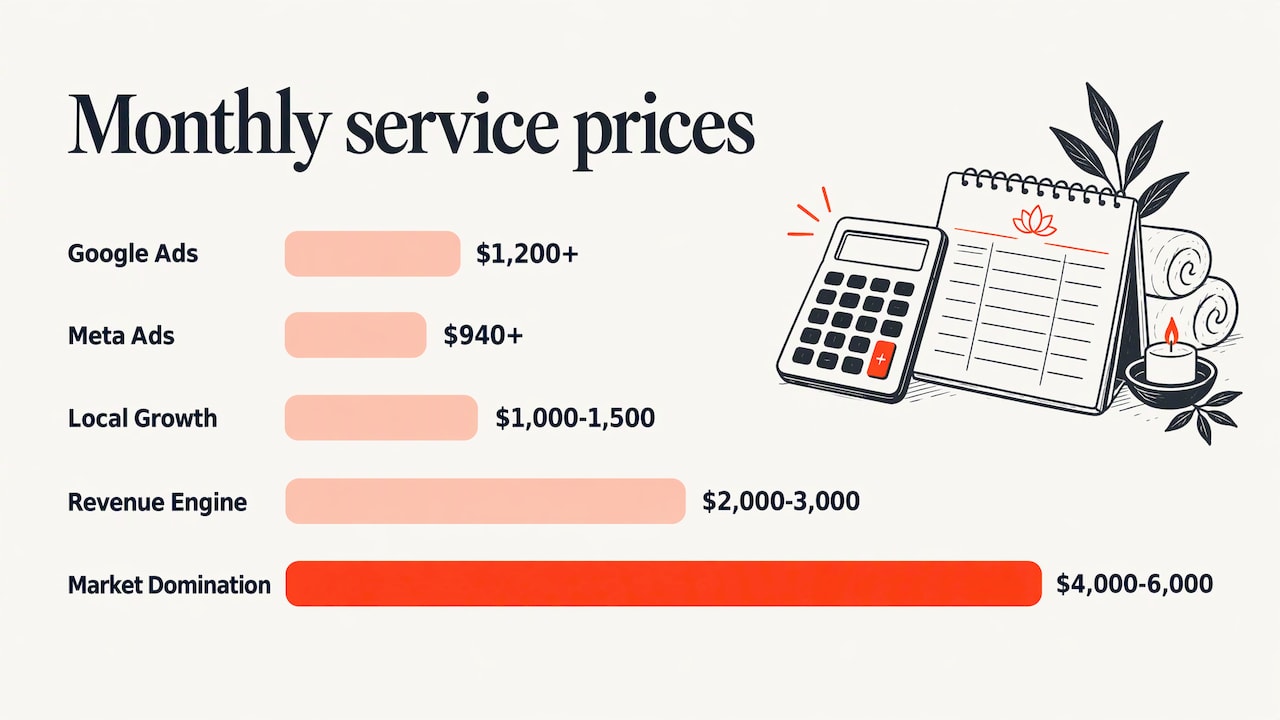
- Our published pricing: Google Ads management from $1,200 per month, Meta Ads management from $940 per month, and SEO plans from $1,000 to $6,000 per month, with no long-term contract.
- Med spas that advertise results must follow FTC rules on testimonials and before-and-after photos.
Why spa marketing is its own problem
A spa sells a treatment that people schedule in advance, often for a special occasion, and a good client returns many times a year. That makes marketing a two-part job: win the first booking, then bring the client back.
The location of the business shapes how hard the first part is. American Spa's business reporting says stand-alone day spas and med spas carry all of their own operating, payroll, product and marketing costs, with typical margins of 10 to 15%. It adds that spas inside resorts or attached to dermatology and plastic surgery practices can reach far higher margins because clients are already on site. A stand-alone spa has to create its own traffic, and that is why marketing efficiency matters more for you than for a hotel spa.
The mix of spas in the US also explains why local marketing dominates. The International SPA Association's 2011 industry study found day spas made up 79% of US establishments, and that 95% of spas used their own website and 81% used social media. That study is old, but the pattern holds: most spas compete for the same neighborhood customers, so the one with the clearest local presence and the fastest response wins the booking.
The marketing services a spa actually needs
Spa marketing services come in six groups. You rarely need all of them at once, but you need to know what each one is for.
Local SEO and Google Business Profile
When someone searches for a massage, facial or spa day near them, Google shows a map with three businesses first. Your Google Business Profile (the free listing with your hours, photos, reviews and booking link) and your local SEO decide whether you appear there.
PatientNow's 2026 lead-generation guide rates the Google Business Profile as high local intent and free, with results in weeks, while organic SEO is high intent and low cost but takes three to six months or more to build. Local SEO is the base layer. It keeps producing bookings after you stop paying for clicks.
Our local SEO and Google Business Profile service covers the listing and the local ranking work, and on-page SEO makes each treatment page match what people type.
Google Ads
Google Ads puts you in front of people at the moment they search. The strongest spa campaigns are narrow: a search such as a couples spa day in your city goes to a page built for that one offer, not to your home page. The same PatientNow guide ranks Google Ads as very high intent with results in days, at a medium to high cost.
Speed is the benefit, and discipline is the requirement. A campaign needs correct conversion tracking, tight location targeting and negative keywords so you do not pay for searches like spa jobs or spa school. Our Google Ads management starts from $1,200 per month.
Meta Ads on Facebook and Instagram
Meta Ads work differently. People are not searching, so the ad has to earn attention with a visual and an offer: a first-visit treatment, a seasonal package, a gift card. Pabau's med spa guide notes that Facebook and Instagram lead campaigns can target a 10 to 20 mile radius and collect consultation requests inside the app, which suits a spa with a defined service area.
Meta is also the natural home for retargeting: showing ads to people who already visited your site or engaged with your Instagram. Our Meta Ads management starts from $940 per month.
Landing pages and website conversion
Ads and search only pay off if the page that follows makes booking easy. A spa visitor is usually on a phone, comparing two or three options. The page should show the treatment, the price or price range, a clear Book button, a few reviews and short answers to common questions.
Vagaro's spa marketing playbook advises sending ads to a service page with a Book button, FAQ and social proof rather than to a general home page. We build these pages through landing page design and improve existing sites through website optimization.
Follow-up, email and automation
Most spa revenue comes from clients who come back. Automated messages do that work without staff time: a rebooking reminder after a few weeks, a birthday offer, a win-back note for clients who have gone quiet.
Zenoti's guide suggests the highest-return email campaigns are rebooking reminders 4 to 6 weeks after a visit, birthday offers a week ahead and win-backs after 60 days of inactivity. Our email nurture and follow-up systems set up this kind of sequence, and we also offer Go High Level CRM setup and AI voice and automation through our marketing services.
Reputation and AI search visibility
Reviews decide close calls. A spa with a steady flow of recent, genuine reviews beats a nearby competitor with a handful of old ones. People also increasingly ask AI assistants where to book, which is why we offer AI search visibility as part of our services.
Day spa or med spa: how the plan changes
The two types buy different things.
| Day spa | Medical spa | |
|---|---|---|
| Typical first booking | Massage, facial, spa day, couples package | Consultation, injectables, laser, skin treatments |
| Best first channels | Google Business Profile, local SEO, Meta offers, gift cards | Google Ads, local SEO, Meta lead forms, referrals |
| Value of a returning client | Steady, many small visits | Higher per visit, repeat treatments through the year |
| Special rules | Standard advertising law | Standard advertising law plus tighter care with health and results claims |
| Follow-up priority | Rebooking and memberships | Consultation reminders and treatment plans |
The practical difference is what each client is worth. A day spa with a modest average ticket needs a lean funnel: strong local search, an efficient offer and a high repeat rate. A med spa can support a larger spend per new client because each one books treatments repeatedly. That is the reason a cost-per-lead figure means nothing until you set it against what a client is worth to you over a year.
What each channel costs you in time
Speed to results varies a lot, and owners who expect everything in week one end up cancelling campaigns just before they work. Vagaro's playbook gives rough timing: Google Business Profile and local SEO take one to three months for new clients, email rebooking works immediately, Instagram and TikTok need three to six months, and paid ads start immediately.
That points to a sensible sequence:
1. Weeks 1 to 2: fix the Google Business Profile, set up tracking and build the booking page. 2. Weeks 2 to 6: launch Google Ads on a few high-intent searches and Meta retargeting to your existing site visitors. 3. Month 2 onward: add Meta offers to cold audiences and start the email and SMS follow-up flows. 4. Months 3 to 6: local SEO and content begin to carry more of the load, so paid spend can be tuned rather than increased.
PatientNow's Zac Degraide makes the same point about balance: the strongest med spa programs run several channels at once so the pipeline does not dry up when one slows.
What to measure
Vanity numbers such as followers, likes and impressions feel good and tell you nothing about the calendar. Five numbers matter.
- Cost per lead: total ad spend divided by inquiries (calls, form fills, chats, booking requests).
- Cost per booked appointment: total spend divided by appointments actually on the calendar. This is the number Vagaro recommends tracking, and it is far more honest than cost per lead.
- Show rate: the share of booked appointments that attend. Reminders help here.
- Customer acquisition cost (CAC): all marketing cost, including agency fees, divided by new clients won in the same period.
- Revenue per client over 12 months: the figure that tells you how much CAC you can afford.
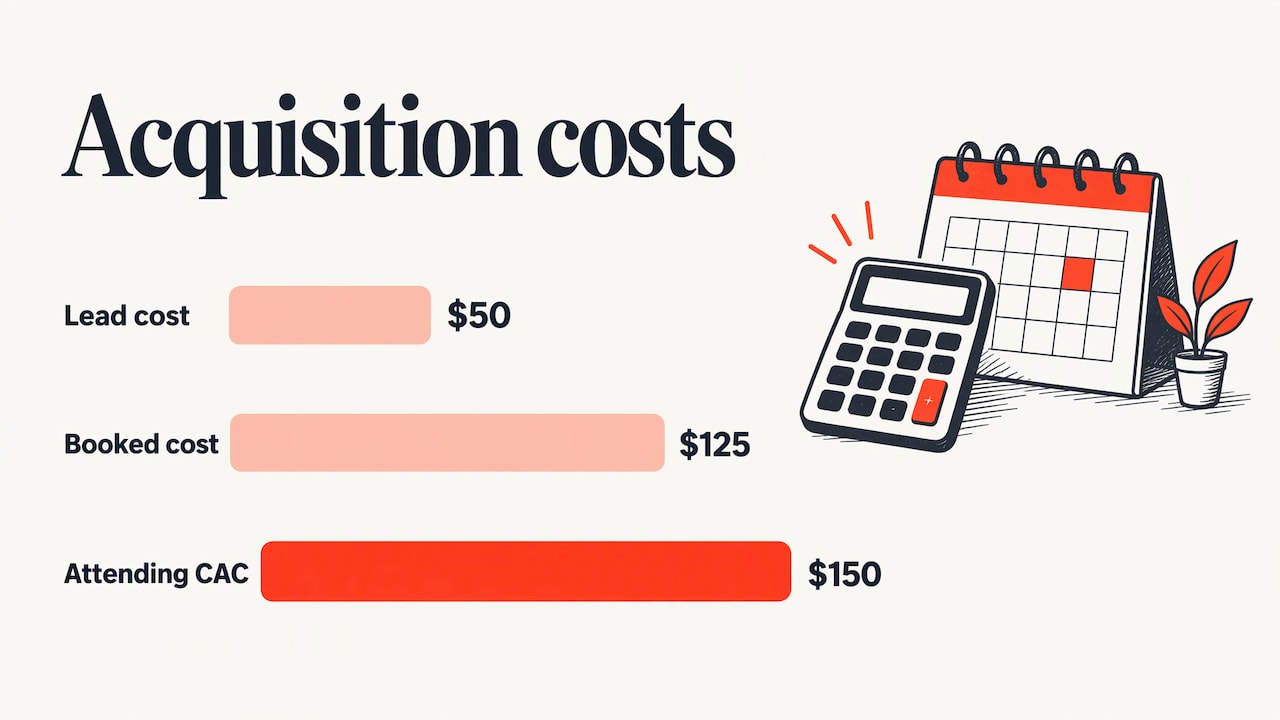
A worked example: you spend $3,000 in a month on ads and agency fees and receive 60 inquiries, so your cost per lead is $50. Of those, 24 book and 20 show up, so cost per booked appointment is $125 and CAC per attending new client is $150. If an average new client spends $90 on the first visit and $400 over the following year, $150 acquires a client worth $490. If your average client spends $90 total, the same $150 is a loss. The campaign did not change. Your economics did.
Two habits keep the numbers honest. First, give a campaign time: Vagaro recommends four to six weeks before judging an ad, because weekly changes made on a hundred impressions teach you nothing. Second, make sure every call and form is tagged to its source. Without call tracking and conversion tracking, you cannot tell which ad produced the booking. We set up conversion tracking so each campaign is measured against revenue rather than clicks.
Speed to lead: where bookings are lost
Many spa leads are lost after the ad has done its job. PatientNow's software guide reports that 40% of med spa clients book after business hours, and that replying within 5 minutes makes you eight times more likely to connect than replying after 30. Those are vendor-reported figures, so treat them as a direction rather than a promise, but the logic is easy to test against your own inbox: an inquiry that sits overnight is an inquiry a competitor can answer first.
Three fixes cover most of the gap:
- An instant text or email reply that confirms the request and offers a booking link.
- A missed-call text-back so unanswered calls turn into conversations.
- A CRM (the system that records every lead and what happened to it) that shows who inquired, who booked and who never replied.
Our AI voice and automation service and Go High Level CRM setup are built for this stage: capturing the lead, replying and keeping the record in one place.
Offers that attract clients without constant discounting
Discounts bring in people who shop on price and leave. Better offers give a reason to try you without cutting the value of your regular menu.
- A first-visit experience with a clear price and a defined scope, such as a signature facial, rather than a percentage off everything.
- Gift cards timed to seasons. Vagaro suggests planning seasonal pushes about six weeks out, so Mother's Day gift-card campaigns start in early April.
- Packages and memberships that pay for the next visit up front and make rebooking automatic.
- Local partnerships with gyms, yoga studios, salons and hotels, where you reach the same neighborhood audience with a shared offer.
- Referral rewards for existing clients. PatientNow rates referrals as very high quality and low cost.
Vagaro also advises starting paid spend with retargeting. People who already visited your site or Instagram convert at a better rate than cold audiences, so it is the cheapest place to learn which message works before widening the audience.
Rules medical spas must follow
If you promote injectables, laser or other treatments with results, advertising law applies in full. Two points matter most.
Testimonials and reviews. The Federal Trade Commission's 2024 final rule prohibits buying or selling fake reviews and testimonials, including AI-generated ones, and lets the agency seek civil penalties. Collect reviews only from real clients with real experience, and never write or buy them.
Before-and-after photos. MedSpa Standards summarizes the FTC position this way: photos should show typical results, or clearly disclose the generally expected performance when they show atypical ones. Edits that enhance the apparent result must be disclosed, and patient photos need a separate signed written authorization that states how they will be used. Have your medical director or healthcare attorney review your advertising copy and photo policy before campaigns go live, and give any agency the approved wording to use.
What spa marketing services cost
Spa marketing is priced as a monthly retainer, often with a setup fee, plus your own ad spend paid to Google and Meta. When you compare quotes, check three things: whether ad spend is included or separate, whether you are locked into a contract, and what you receive each month as reporting.
Our published pricing, as read from our site in November 2026:
| Service | Price |
|---|---|
| Google Ads management | From $1,200 per month |
| Meta Ads management | From $940 per month |
| Local Growth plan | $1,000 to $1,500 per month |
| Revenue Engine plan | $2,000 to $3,000 per month |
| Market Domination plan | $4,000 to $6,000 per month |
The three plans are on our SEO packages page. Fees are flat-rate, there is no long-term contract, and some work, such as onboarding and foundational setup, carries a one-time fee. Other services, including landing pages, local SEO and email nurture, have no published price, so ask us for a quote.
A simple way to size a budget: work backward from the calendar. If you want 20 new clients a month and your funnel turns 40% of leads into attending clients, you need 50 leads. Multiply that by the cost per lead you are achieving, add the retainer, and compare the total to the first-year revenue from those 20 clients.
How we work with spas
We focus on performance marketing for local service businesses, and spas are among the industries we serve. Our approach combines Google Ads, SEO, Meta Ads, AI voice automation and CRM setup so the funnel is one connected system rather than separate tasks handled by separate vendors. Every campaign is tracked to revenue, and you can leave without a long-term obligation, which keeps the focus on results.
If your calendar has gaps or your cost per booked appointment is rising, the first step is a look at where leads come from and where they drop off. Start on our main site, or choose a plan on the SEO packages page.
Common mistakes to avoid
- Sending ads to the home page. A visitor looking for a facial should land on the facial page.
- Judging too early. Four to six weeks of data beats a weekly reaction.
- Counting leads, not bookings. Ten cheap inquiries that never book are worse than four that do.
- Slow replies. The fastest responder often gets the booking.
- Ignoring existing clients. Rebooking flows cost little and protect the most profitable revenue you have.
- One channel only. Relying on a single source leaves you exposed when it slows.
FAQ
What are spa marketing services?
They are the services that bring new clients to a spa and bring existing ones back: local SEO, Google Ads, Meta Ads, landing pages, email and text follow-up, CRM setup and reporting. The goal is booked appointments, not traffic.
How do I get more spa clients quickly?
Google Ads on specific local searches, sent to a dedicated booking page, is the fastest route because it starts producing inquiries within days. Pair it with a fast reply to every lead and a Google Business Profile with current photos and reviews.
How much should a spa spend on marketing?
Work backward from the number of new clients you want and what a client is worth over a year. Agency management for a single channel starts around $940 to $1,200 per month with us, and ad spend is paid to the platform on top of that.
How long before spa marketing shows results?
Paid ads can produce inquiries within days, and Google Business Profile work often shows within weeks. Organic SEO usually takes three to six months to build, so plan for a stepwise ramp rather than an instant one.
Do med spas need special care with advertising?
Yes. Reviews must be genuine, and before-and-after photos must show typical results or disclose what is typical, with signed patient authorization. Have your medical director or healthcare attorney approve claims before they run.
Sources
- Do You Know Your Spa's Financial Ratio? | American Spa
- International SPA Association Releases 2011 U.S. Spa Industry Study
- How to generate leads for a medical spa | PatientNow
- Top 10 med spa software features that drive revenue | PatientNow
- 7 Lead generation ideas for med spas | Pabau
- The Spa Marketing Playbook | Vagaro
- Digital Marketing for Salons & Spas | Zenoti
- FTC Announces Final Rule Banning Fake Reviews and Testimonials
- FTC Before and After Photo Rules for Med Spas | MedSpa Standards
Want this handled for you?
We run Google Ads, Meta Ads, and SEO for local service businesses. Book a call and we will show you what your numbers could look like.