# Pool Service Leads: How to Get Qualified Ones in 2026
A pool service lead is only worth paying for if it ends in a booked route stop, repair or build. The companies that get steady, qualified leads treat lead generation as one connected system: a channel that reaches people who need pool work in their service area, a fast response, and tracking that follows each lead through to revenue. Roxfire Marketing Agency builds that system for local service businesses, including pool builders, and ties campaigns to booked revenue rather than clicks.
This guide is for owners and managers of pool service, repair and building companies. It covers what a qualified lead is, which channels fit which jobs, how to respond, and how to tell whether your marketing is paying for itself.
- A qualified pool lead is a person who needs work you actually do, in an area you actually serve, with timing and budget that fit your capacity. A raw call or form fill is not the same thing.
- Match the channel to the job: search ads and local SEO for people looking right now, social ads for building and remodel interest, referrals and partnerships for recurring routes.
- Speed of follow-up and a clean intake script decide how many leads become booked jobs.
- Judge marketing by cost per booked job and revenue by source, not cost per lead alone.
- No honest agency can guarantee a lead count. Ads need a real budget and SEO takes months to build.
What counts as a qualified pool service lead
A lead is anyone who contacts you. A qualified lead is a contact you would gladly schedule. The difference is where most pool marketing money gets wasted.
A useful test is to check each inquiry against a short list:
- Service address: is it inside the ZIP codes or towns you serve?
- Requested work: weekly cleaning, green-pool recovery, equipment repair, a seasonal opening or closing, a remodel, or a new build?
- Pool details: type of pool, surface, equipment and access (gate, dogs, locked yard).
- Authority: is the person the owner, or a renter or neighbor asking for a friend?
- Timing and price range: are they ready to book in a window you can serve, and does the job fit what you charge?
- Capacity: do you have an open recurring route slot or crew week for this job?
A recurring cleaning lead in a ZIP code that sits 40 minutes off your route costs you drive time every week. A green-pool recovery request can be a good one-time job and sometimes the start of a route. A new-build inquiry from someone with no budget conversation yet is a long-cycle prospect. All three are leads, and each needs different handling. Decide up front which ones you want more of, because that decision shapes your ads, your landing pages and your intake questions.
If you build pools, your qualified lead looks different again: property ownership, lot suitability, budget range and project timeline matter more than route fit. Our pool builder marketing page covers that side in detail.
Which channels produce pool leads, and when each fits
There is no single best channel. Each one reaches people at a different moment, and each has a different cost structure. Here is how they sort by job type.
| Channel | Who it reaches | Best for | Time to results | Cost structure |
|---|---|---|---|---|
| Google Ads (search) | People searching right now, such as "pool pump repair near me" | Repairs, green-pool recovery, new route accounts | Days to weeks, once tracking and landing page are set | You pay per click, plus a management fee |
| Local SEO and Google Business Profile | People searching locally, including map results | Steady inbound calls over time | Typically months | Mostly time and ongoing work |
| Meta Ads (Facebook and Instagram) | People who were not searching but live in your area | Remodels, builds, seasonal openings, promotions | Weeks, with creative testing | You pay per impression or click, plus a management fee |
| Referrals and partnerships | Customers of other local businesses | Recurring routes, high-trust jobs | Slow to build, durable | Mostly relationship time |
| Email follow-up | Past customers and unconverted leads | Reactivation, upsells, seasonal reminders | Immediate once a list exists | Low per-message cost |
Search ads: for people who need help now
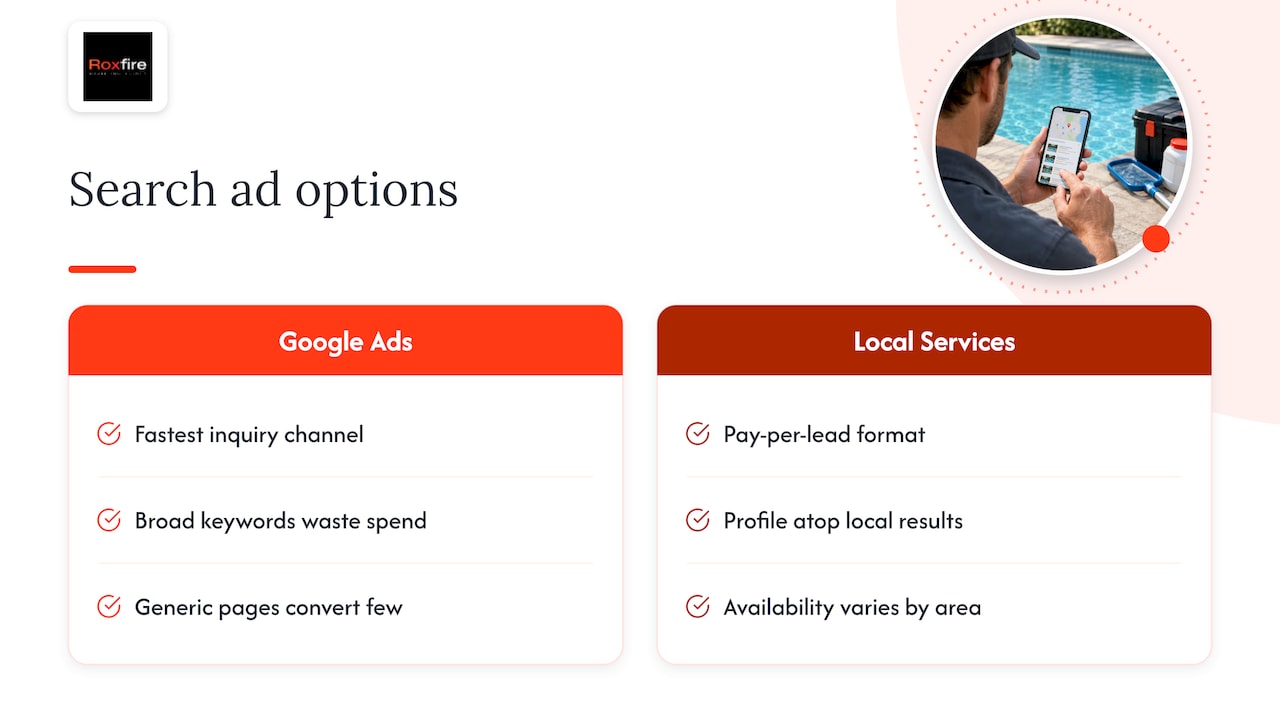
Someone whose pump has stopped or whose pool has turned green is already shopping. Google Ads puts your company in front of that search. It is the fastest of these channels to start producing inquiries, and it is also the one where poor setup burns money fastest: broad keywords pull in people looking for pool supplies, DIY advice or jobs, and a generic homepage converts few of them. We cover the mechanics in our guide to Google Ads leads for local service businesses.
Google also offers Local Services Ads, a pay-per-lead format that shows a business profile at the top of results for local services. Availability depends on the category and your area, so confirm it in your own Google Ads account.
Local SEO: the slower, compounding channel
Local SEO means improving how your business appears in map results and local search. That covers your Google Business Profile, the pages on your site for each service and city, and the reviews you collect. It does not produce a flood of calls in week two. It typically takes months to build, and then it keeps working without a per-click charge. The same principles apply across trades, as we explain in our local SEO guide for HVAC companies. Builders can read our pool builder SEO strategy.
Social ads: for projects people did not know they wanted yet
A remodel, a new build, an automation upgrade or a salt-system conversion often starts as an idea triggered by a photo, not by a search. Meta Ads place your finished projects in front of people in your service area. This works best with strong project photos and a clear offer, such as a consultation or a design visit. Our landscaping Facebook ads guide shows how project-based trades structure these campaigns, and the same approach carries over to pool builds and remodels.
Referrals and partnerships: the route builders
Recurring accounts often come from people who already trust someone else. Jobber's growth guide recommends partnerships with pool builders, property managers, real-estate agents and landscapers, and making referrals easy to share. In practice, that means a one-page handoff: what you offer, how to reach you, and a simple way for the partner to send a customer your way. Ask for reviews at the right moment too. The same guide advises asking shortly after a successful visit or resolved problem, while the experience is fresh.
Start with one or two channels
A small company spreading a modest budget across five channels usually learns little from any of them. Pick the one or two that match your most profitable job type, get them tracking properly, then add another.
What pool leads cost, and why the price on the label misleads
You will see lead-selling services quote a flat price per lead. Before you compare them with running your own campaigns, understand what changes the real cost:
- Exclusivity: a shared lead goes to several companies at once, so you compete on speed and price. An exclusive lead goes to one.
- Fit: a cheap lead outside your service area, or for a job you do not do, costs more than it saves.
- Close rate: if you book one in three leads, your cost per booked job is three times your cost per lead.
- Job value: a $60 lead that becomes a build can be far better than a $20 lead that becomes a one-time filter clean.
That is why the number to watch is not cost per lead (total marketing spend divided by the number of leads). It is cost per booked job, and then revenue by source. Jobber's guide recommends tracking cost per lead, booking rate and revenue by source together, so that a cheap channel that never books does not look like a winner.
A worked example with made-up round numbers
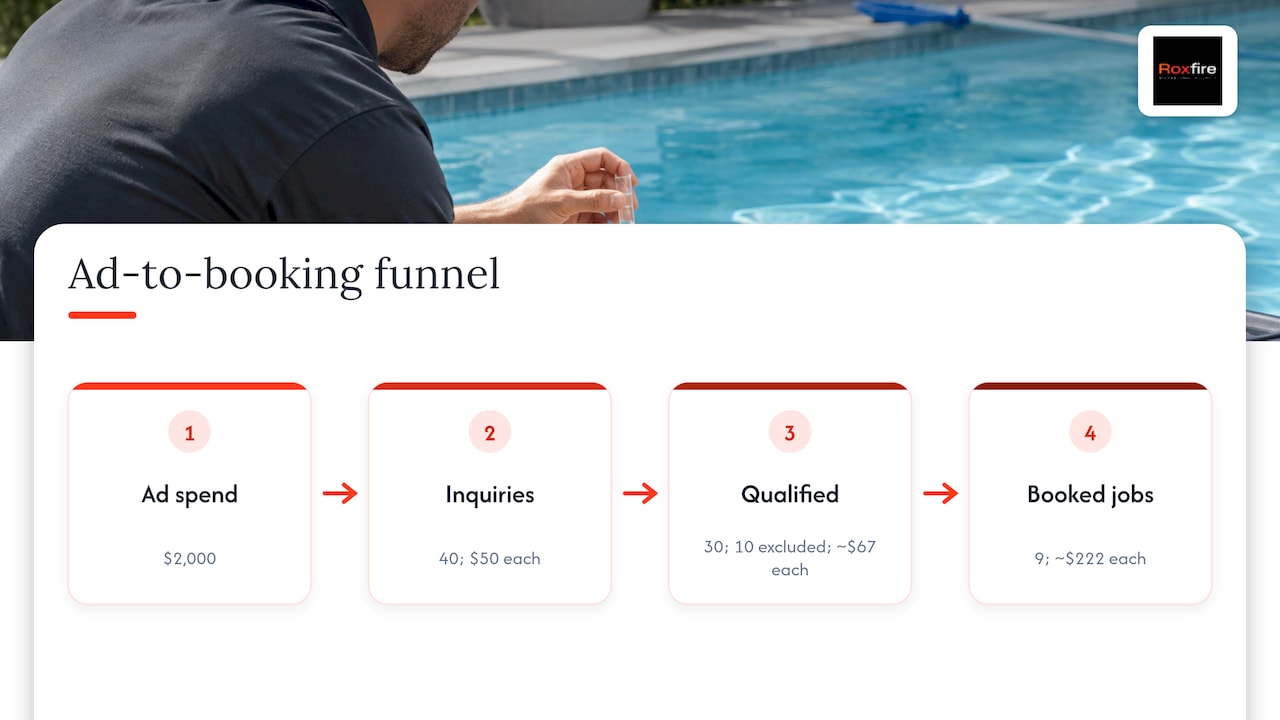
The numbers below are illustrative, not benchmarks. Suppose you spend $2,000 on ads in a month and receive 40 inquiries. That is $50 per lead. Ten are outside your area or are not looking for your service, so 30 are qualified: about $67 per qualified lead. You book 9 of them. Your cost per booked job is about $222. If the average job is a $450 repair, you are close to break-even on the first job, and the math only works if a share of them become recurring customers. If instead the average booked job is a $9,000 remodel, the same $222 looks small.
The same ad account can look good or bad depending on which job you are measuring. Decide the job first, then judge the campaign.
How to respond so leads turn into booked jobs
Marketing brings in the inquiry. What happens in the first hour usually decides whether it becomes revenue. A repeatable routine looks like this:
1. Answer fast. Someone with a dead pump or a green pool is calling more than one company. Missed calls and slow replies hand them to whoever picks up. 2. Confirm the basics. Address, ZIP, the problem or project, and pool type. This is the qualification checklist from earlier, turned into a script. 3. Check fit. Is it in your service area and on a day you can serve? 4. Book the next step. An appointment, a quote visit or a first-clean date, rather than "we'll get back to you." 5. Follow up on the ones who do not book. Many people compare quotes for days. A text and an email a day or two later recover jobs that would otherwise be lost.
We set this up for clients with CRM and automation, using Go High Level CRM and automation and email nurture and follow-up systems, so every inquiry is logged, followed up and tied to an outcome. For companies that miss calls while working on a pool, we also offer AI voice and automation, which can answer and capture details when no one is free to pick up. Learn about AI voice and automation.
How to measure whether marketing is paying for itself
Track these for each channel, monthly:
- Leads received
- Qualified leads (the ones that passed your checklist)
- Booked estimates or first visits
- New recurring customers or signed builds
- Marketing spend, including the agency fee and the ad spend
- Revenue from those customers
- Time to first response
From these you get qualified-lead rate, booking rate, cost per booked job and revenue per dollar spent. Put them side by side, per channel. If Google Ads brings fewer leads than Facebook but books twice as many, Google is your better channel, whatever the lead count says.
This only works if calls and form fills can be traced back to their source. That is why we set up conversion tracking so each campaign is measured against booked revenue, not vanity metrics like impressions or clicks. Tracking that stops at the click tells you which ad was seen, not which one paid.
Give each channel time to be judged. Ad campaigns need a few weeks of data and some adjustment. SEO needs months. Cutting a channel after ten days because the first numbers looked soft usually means paying for the learning period twice.
Licensing and insurance: check before you advertise
If you advertise a service, you should be allowed to perform it. Requirements for pool work vary by city, county, state and by the work itself, such as chemical handling, plumbing or electrical repairs. Jobber's overview notes that business registration, licensing, insurance and taxes depend on your jurisdiction, and that coverage such as general liability, commercial auto and workers' compensation may apply. Confirm the exact rules with your state licensing board or local government before you advertise a new service. If you do, advertise your licensing and insurance on your pages, since homeowners often look for it.
Why a specialist agency makes this easier
Each piece above is manageable alone. Together they make a part-time job: structuring campaigns, writing ads, building landing pages, keeping Google Business Profile current, answering every lead, and reconciling spend against booked jobs. In peak season, that work is what slips first.
Roxfire works only with local service businesses, and every campaign is tracked directly to revenue. That means your reporting shows booked jobs and the money behind them. There are no long-term contract obligations, so the relationship rests on what the numbers show.
What it costs with Roxfire
Our published pricing, so you can plan:
- Google Ads management: starts at $1,200 per month.
- Meta Ads management: starts at $940 per month.
- SEO plans: Local Growth is $1,000-$1,500 per month, Revenue Engine is $2,000-$3,000 per month, and Market Domination is $4,000-$6,000 per month. See the SEO packages.
Ad spend is paid directly to the ad platforms and is separate from our management fee. Budget for both. A pool company that can only fund the fee and almost no ad spend will not give a campaign enough volume to learn from.
We do not guarantee a number of leads, because no one honestly can. What we commit to is setup, transparent reporting and ongoing optimization against your cost per booked job.
The simplest next step is a free marketing audit. We look at how your current ads, website, Google Business Profile and follow-up are working, and show where the gaps are. Book your free marketing audit with Roxfire.

Where to start this month
You can improve lead quality without changing your budget:
1. Write down your three most profitable job types and your service-area ZIP codes. 2. Turn the qualification checklist into a short intake script that everyone who answers the phone uses. 3. Pick one or two channels that match those jobs. 4. Set a rule for first response time, and review missed calls weekly. 5. Record, for every lead, whether it booked and what it earned.
After a month, you will know which leads are worth more of.
FAQ
How much should a pool company spend on marketing?
There is no single right figure, because it depends on your average job value, your close rate and how fast you want to grow. A company selling $9,000 remodels can support higher cost per lead than one cleaning pools on a monthly route. Work backward from the revenue you want and your booking rate. Then add the management fee to the ad spend, since both are part of the cost.
Are exclusive pool leads better than shared ones?
Exclusive leads go only to your company, so you are not racing other bidders, and they typically close more easily. What matters is still fit: the right area, the right service and a person ready to book. Compare any lead source by cost per booked job, not by the price of each lead.
How long does it take to get pool leads from SEO versus ads?
Paid ads can start producing inquiries within days to weeks once tracking, ads and landing pages are in place, then improve with adjustment. Local SEO is slower and typically takes months to build, but it keeps producing inquiries without a per-click charge. Many companies run both, with ads covering the gap while SEO grows.
What is the difference between a pool service lead and a pool builder lead?
A service lead is usually a recurring or repair request that depends on route fit and speed of response. A builder lead is a longer-cycle project with a larger job value, where budget, property and timeline matter most. They need different ads, landing pages and follow-up.
Want this handled for you?
We run Google Ads, Meta Ads, and SEO for local service businesses. Book a call and we will show you what your numbers could look like.