# Garage Door Leads: How to Get Qualified Calls in 2026
A garage door lead is a person who has a broken spring, a dead opener or a new-door project and has contacted a business about it. The best leads for a garage door company come from channels you control: Google Ads aimed at urgent repair searches, a Google Business Profile and local SEO for steady calls, and a phone process that answers fast. Roxfire Marketing Agency builds that kind of system for local service businesses, and every campaign is tracked to booked revenue instead of raw call counts. Below, we walk through where leads come from, what you pay for each type, and how to tell a qualified lead from a wasted one.
- Leads come from four places: paid search, organic search and maps, referrals and reviews, and bought lead marketplaces. Only the first three build an asset you own.
- Shared, exclusive and aged leads differ in how many companies get the same inquiry. Fewer competitors per lead usually means a higher price per lead but a better chance of booking the job.
- Judge any source by cost per booked job, not cost per lead. That needs tracking from first call to paid invoice.
- Garage door work is urgent. Speed of answer often decides who gets the job, so your phone process matters as much as your ads.
- SEO takes months to build and paid ads need a real budget. Nobody can honestly guarantee a lead count, and Roxfire does not.
What counts as a qualified garage door lead
A lead is qualified when four things are true:
1. It is in your service area. A broken spring 40 miles outside your territory is a cost, not a lead. 2. It is a job you do. Residential repair, spring and cable replacement, opener installs, new doors, commercial dock doors. Know which you want. 3. The person is ready to act. Someone with a car trapped in the garage is ready now. Someone browsing door styles for next year is a longer conversation. 4. It is a real, unique person. Not a duplicate, a bot form fill or a competitor checking your prices.
Write these four rules down before you spend a dollar. They become the filter for every channel below, and they are the definitions you give your office staff or any marketing partner.
It also helps to split leads by intent. Emergency intent is a stuck door, a snapped spring or a door off its track. These callers usually call the first two or three companies they find and book whoever picks up. Planned intent is a new door, an opener upgrade or a quote for a better-insulated model. These customers compare, read reviews and take days. A good marketing plan treats them as two different jobs with different ads, pages and follow-up.
Where garage door businesses get leads
Paid search (Google Ads)
When a homeowner types "garage door spring repair near me," the ads at the top of the results appear within seconds. Google Ads is the fastest way to be in front of that urgent search, because you choose the keywords, the service area and the hours your ads run. Pay-per-click means you pay when someone clicks, whether or not they call, so the quality of your landing page and call tracking decides whether the money turns into jobs.
The tradeoff: paid ads need a real budget and a few weeks of learning and adjustment before they settle. Bad keyword choices are expensive. A broad term like "garage door" pulls in people shopping for pictures or looking for a job, while a specific phrase like "garage door off track repair" pulls in people who need you today. For a deeper look at what a click and a lead cost in this trade, see our guide to Google Ads cost per lead for home services and our piece on how local service businesses get qualified Google Ads leads.
Local Services Ads
Google also runs Local Services Ads, a pay-per-lead format where the ad shows a verification badge and you pay for contacts rather than clicks. Businesses go through a screening and verification process before they appear, so expect paperwork, license and insurance checks, and some waiting time before the first lead arrives. It is a useful complement to standard search ads, not a replacement for a website that converts.
Organic search and your Google Business Profile
Your Google Business Profile is the free listing that shows your name, reviews, hours and phone number on the map. Local SEO is the work of making that profile and your website rank for the services and towns you cover. It pays off slowly and keeps paying: once a service page ranks for "garage door opener installation" in your city, calls arrive without a per-click charge.
Be realistic about timelines. SEO takes months to build, not weeks, and a new site competing against established companies needs patience. That is why most garage door companies run ads for immediate calls while SEO builds. A strong structure is one page per service (springs, openers, new doors, commercial) and one page per major city you serve, each with real photos and details instead of copied text. Our garage door repair marketing guide covers this in more detail.
Referrals and reviews
Happy customers, property managers, realtors and builders send repeat work. Reviews do double duty: they send referrals and they push your map ranking up. Ask every customer at the moment the door works again, by text, with a direct link to your review page. This is the cheapest source of leads you will ever have, but it grows as fast as your job count, so it cannot be turned up on demand.
Lead marketplaces and lead sellers
Some companies sell garage door inquiries by the lead. You pay per contact, and the seller owns the relationship with the homeowner. Convenient, yes, but you are renting access to demand. We cover how these leads differ next.
How to check lead quality and avoid paying for waste
Whatever the channel, run the same checks:
- Duplicates. Does the same phone number show up twice in a week? Log every lead and flag repeats. Ask any lead seller how they handle duplicates before you sign up.
- Out-of-area contacts. Check the ZIP code of every lead against your service area. In paid search, exclude locations you do not serve and set the geographic targeting to people in the area, not people merely interested in it.
- Low-intent inquiries. Job seekers, parts-only buyers, price-checkers and DIY questions inflate lead counts. In Google Ads, add negative keywords (terms you tell Google never to show your ad for), such as "jobs," "training," "DIY" or "parts only."
- Call quality. Listen to a sample of recorded calls each month. If a third are wrong numbers or outside your area, the channel needs fixing, not more budget.
- Outcome. For every lead, record what happened: answered, quoted, booked, completed, paid. A lead source is only as good as its booked-job rate.
This is where most garage door owners get stuck. The ads dashboard shows clicks and calls, the office has a notebook or a basic system, and nobody can connect the two. You end up paying for "leads" without knowing which ones paid you.
Track every lead from first call to paid invoice
A customer relationship management system (CRM) is software that keeps every inquiry, quote and job in one place. For a garage door company, a useful setup records:
- the lead source (which ad, which page, which referral)
- the door or opener problem and the address
- photos the customer sent
- the estimate and whether it was accepted
- the technician assigned and the follow-up date
- warranty details and a review request after the job
The point is to measure booked revenue by source, not call volume. If Google Ads produced 60 calls and the map listing produced 25, but the map calls booked twice as often, you want to know that before moving budget. Roxfire sets up conversion tracking and CRM automation, including Go High Level CRM, so that campaigns are tracked to revenue. We steer away from adding tracking tools to your site by default; we start with the call and form tracking that the ad platform and CRM already support, and add more only when there is a clear reason.
Win the job after the lead arrives
Many garage door companies lose jobs after the lead is paid for, not before. Three habits fix most of the damage:
1. Answer live. Emergency callers move to the next company when you go to voicemail. If your technicians are in the field and the office closes at 5 p.m., the phone is a leak. Roxfire's AI voice automation is designed to answer calls and capture the details when your team cannot, so the job is not lost while you are on a roof or in a driveway. 2. Follow up fast. For form leads, text or call within minutes with the next step. Quote requests that sit overnight are more likely to book elsewhere. 3. Keep following up. Planned-intent leads, such as new doors and opener upgrades, often need two or three touches over a couple of weeks. Automated email and text sequences (often called nurture campaigns) keep your quote in front of the customer without anyone remembering to do it by hand.
Be honest about your close rate. If you quote 20 jobs a week and book 6, a better price is not always the answer. A faster callback, a clear written estimate and a visible review score usually move the number more than a discount.
What a lead system costs
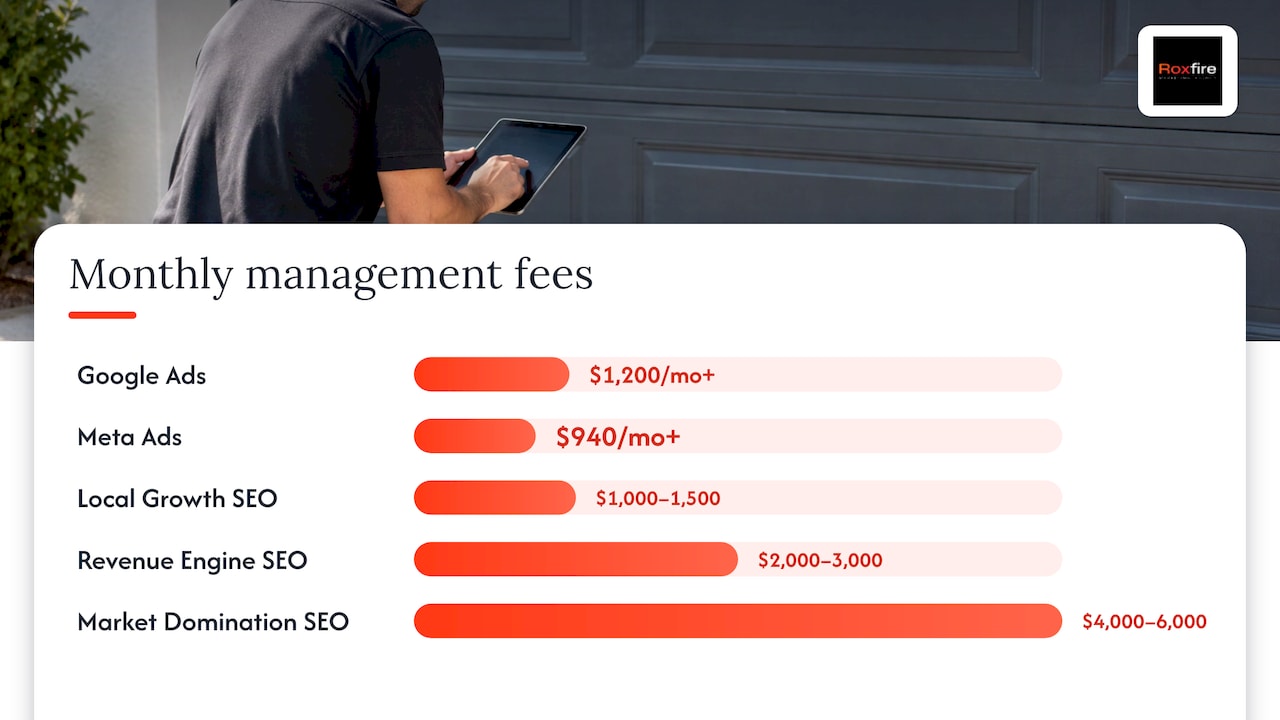
Budget in two parts: the ad spend that goes to the platforms, and the fee for the people who run the program. At Roxfire, Google Ads management starts at $1,200/month and Meta Ads management starts at $940/month. Ad spend is paid directly to the ad platforms and is separate from the management fee. Our SEO packages run from $1,000 to $1,500 per month for Local Growth, $2,000 to $3,000 per month for Revenue Engine and $4,000 to $6,000 per month for Market Domination, with details on our SEO packages page. There are no long-term contracts.
What do those numbers mean for a garage door company? A simple test: if an average job is worth several hundred dollars, work backwards. Take your average ticket, your realistic booking rate on calls and the margin you need, and see what cost per booked job you can afford. Marketing works when that number is lower than your gross profit per job. If it is not, the problem is in the offer, the phone process or the targeting, and a good agency will tell you which.
Paid ads usually produce activity within weeks, while SEO results build over months. A realistic plan for most garage door companies is ads first for immediate calls, with local SEO started in parallel so the share of calls you do not pay for rises over time. We never guarantee a number of leads, because ad auctions, seasons and local competition move too much for anyone to promise that honestly.
Why a managed program beats buying leads alone
Buying leads is quick: you pay, and contacts arrive. But you are building nothing. The leads are visible to the seller's other buyers in the shared model, you cannot see what the ads or pages behind them look like, and the price follows demand, which rises when your competitors bid.
A program you own works differently. Your ads, landing pages, Google profile and CRM data stay with your business. Every call recorded, every estimate logged and every booked job tied to a source teaches you where the next dollar should go. That is the approach behind our garage door marketing work: Roxfire specializes in performance marketing for local service businesses, and every campaign is tracked to revenue rather than vanity metrics.
How Roxfire helps garage door companies
Roxfire combines Google Ads, Meta Ads, local SEO, landing pages, AI voice automation and CRM setup for local service businesses, including garage door repair and installation companies. We build the funnel from the search or ad through the call or form, the follow-up and the booked job, so you can see which spend turned into revenue.


If you want to see where your current calls and ad spend are going, book a free marketing audit with Roxfire at roxfire.io. We will look at your ads, your Google profile, your site and your call handling, and show you what is working and what is leaking.
FAQ
How much do garage door leads cost?
It depends on the type and the market. Shared leads cost less per contact, exclusive leads cost more, and aged leads are cheapest. Pay-per-click ads and pay-per-lead ads price by competition in your area and the season. The number that matters is your cost per booked job, which only tracking can tell you.
Are exclusive garage door leads worth it?
Exclusive leads avoid the race against other companies, so they tend to book at a higher rate than shared ones. Whether they pay off depends on your close rate and how quickly you respond. Compare the cost per booked job against your other sources before committing more budget.
How long does it take to get garage door leads from Google?
Paid ads can start producing calls within days to a few weeks of launch, then need adjustment as data comes in. SEO and map rankings usually take months. Combining both gives you immediate calls and a growing base of calls you do not pay for per click.
How do I know if a lead is qualified?
Check that it is in your service area, for work you do, from a real person who needs the job soon, and not a duplicate. Record the outcome of every lead in a CRM so you can see which sources book jobs and which only produce calls.
Want this handled for you?
We run Google Ads, Meta Ads, and SEO for local service businesses. Book a call and we will show you what your numbers could look like.