If you run an HVAC, roofing, plumbing, solar, restoration, or garage door company, you've probably noticed the rules have shifted. Click costs are harder to control directly. Match types behave less predictably. Performance Max wants to spend your budget faster than you can audit it. And every Google notification seems to nudge you toward "let AI handle it."
That's the trend, not the exception. AI marketing for home service businesses has moved from buzzword to operating layer. Google, Meta, and the major lead-gen platforms now bake AI into bidding, targeting, creative, and measurement. The question for owners and operators is no longer whether AI is in your ad account - it already is. The question is whether it's been set up to help you, or quietly working against your unit economics.
This article is a plain-English guide to what AI is actually doing in home service marketing right now, where it's helpful, where it's risky, and what to look for when you evaluate your own setup or your current agency.
What "AI marketing" actually means in 2026
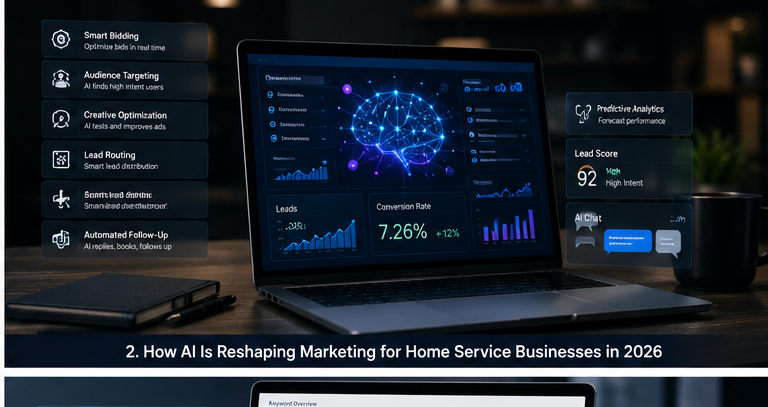
Three years ago, "AI in marketing" mostly meant chatbots and a few headline generators. In 2026, AI sits inside almost every layer of paid media:
- Bidding & budget pacing. Smart Bidding now factors hundreds of signals per auction - query intent, device, time of day, on-site behavior, and more.
- Audience targeting. Tools like AI Max for Search and Performance Max expand reach beyond exact keywords by interpreting intent.
- Creative generation. Google's Asset Studio (including the Nano Banana Pro image model) and Gemini-powered AI Brief let advertisers generate and steer creative inside the ad platform itself.
- Conversion modeling. When tracking signals are missing - iOS restrictions, cookie loss, consent denials - modeling tries to fill the gaps so bidding still has data to learn from.
- Lead handling. On the CRM side, AI scoring, routing, and follow-up tools are used to triage inbound leads before a human picks up the phone. Increasingly that includes the phone itself: AI voice systems can answer calls around the clock, ask qualifying questions and book appointments, then hand the conversation to your team when a person is needed.
For a home service business, every one of those layers used to require a different specialist or vendor. Today they're bundled into the platforms - useful if you know what to feed them, risky if you don't.
Where AI is genuinely helpful for HVAC, roofing & plumbing companies
1. Matching messy local intent
Search behavior in home services is rarely tidy. Homeowners search "AC not blowing cold," "leak under kitchen sink," or "shingles flew off roof storm last night" at moments of urgency. These queries don't fit cleanly into traditional keyword lists.
Modern AI matching is better at recognizing the underlying job to be done and pairing it with the right ad. When tracking and exclusions are configured correctly, this can help reduce wasted spend on irrelevant clicks and improve the share of clicks that come from genuine buyers.
2. Faster creative iteration
A roofing campaign during hurricane season needs different messaging than the same campaign in February. Historically, agencies rotated creative manually every few weeks. Today, AI-generated headline and image variants can be tested at higher volume, and winning combinations surface faster - assuming a human reviews them for accuracy, compliance, and brand fit before they go live.
3. Better signal-to-noise on inbound leads
This is where AI is reshaping the back half of the funnel - not just ad delivery, but lead handling.
AI lead scoring tools can rank inbound calls and form fills by indicators like service-area fit, urgency, job-size signals, and likelihood to close based on historical CRM data. Combined with fast routing - getting hot leads to your best closer within minutes - this can help shift optimization from "lead volume" to "booked-job quality." It doesn't manufacture more demand, but it helps your sales team spend their time on prospects worth chasing.
4. More complete measurement when consent is fragmented
With privacy regulations expanding and cookie loss accelerating, observed conversion data is shrinking. Modeling and Enhanced Conversions can help fill gaps so bidding strategies have enough signal to optimize. The catch: modeled conversions should always be validated against your CRM data, not trusted blindly.
Where AI quietly burns budget
It's not all upside. The most common ways we see home service operators get hurt by AI-driven ads:
- Performance Max with weak conversion tracking. When the underlying data is wrong, PMax will optimize toward the wrong outcome - efficiently. Performance Max can waste budget quickly when conversion tracking is weak.
- Auto-applied recommendations. Google's "apply automatically" toggles look helpful and often aren't. They're worth reviewing campaign by campaign rather than leaving on by default.
- AI-generated landing pages with no human review. Yes, AI can build a page in 60 seconds. No, it doesn't know your service area, license requirements, warranty terms, or current promotion.
- Over-trusting modeled conversions. When a large portion of your reported conversions are modeled rather than directly observed, your bidding is partly steering on estimates. Modeled conversions should be validated against CRM data.
- Optimizing for the wrong metric. AI bidding will happily get you more leads at higher cost if it's set to optimize for lead volume instead of booked-job value.
Emergency-driven trades are especially exposed to this, because a single mistargeted campaign burns budget fast. The structure that avoids it is covered in our garage door repair marketing guide.
What good looks like: a practical framework
There are no magic settings, but the home service accounts that get the most out of AI marketing tend to share four habits:
- Clean signals in. Server-side tagging where it makes sense, Enhanced Conversions, offline conversion imports from the CRM, and call tracking that stitches GCLIDs to phone leads. AI is only as good as the data it learns from.
- AI for execution, humans for judgment. Use AI to generate variants and surface patterns. Keep human review for messaging accuracy, license and warranty compliance, and anything tied to local market context.
- Frequent, lightweight audits. AI-driven campaigns can drift in days, not months. Lightweight weekly checks (CPL caps, geo exclusions, brand-term protection, asset performance) catch issues before they compound.
- Tie reporting back to revenue. Lead count is a vanity metric. Booked jobs and revenue-per-job are the numbers that matter. The further your reporting drifts from those, the easier it is for AI to optimize toward something that doesn't pay your bills.
What home service business owners should be asking
If you're running ads in 2026 and you can't confidently answer these questions, your AI is probably costing you more than it should:
- Is offline booked-job revenue flowing back into Google Ads via Enhanced Conversions or offline conversion imports?
- Is Consent Mode set up correctly, and do you know your modeled vs. observed conversion ratio?
- Do you have asset-level reporting on Performance Max?
- Is someone reviewing AI-generated assets before they go live?
- Do your ad campaigns optimize toward booked jobs or toward raw lead volume?
A clean answer to all five is rare. When those gaps are closed, results often improve - though specific outcomes depend on your market, budget, tracking quality, sales follow-up, and offer.
The bottom line
AI is no longer optional in home service marketing. It's running in your campaigns whether you set it up correctly or not. The goal isn't to avoid AI - it's to feed it clean signals, set sensible guardrails, and keep human judgment in the loop on creative and strategy.
Roxfire is a performance marketing agency headquartered in Miami that works with HVAC, roofing, plumbing, solar, restoration, garage door, and other home service businesses across South Florida - from Miami and Fort Lauderdale through Broward and Palm Beach - and nationwide. We focus on the unglamorous work that makes AI marketing actually pay off: clean tracking, sharp landing pages, and reporting tied back to booked revenue.
If you want help getting your account in shape for the AI-first era, we're happy to take a look.
Ready to improve lead quality and stop guessing where your ad budget is going? **Book a Free Strategy Call with Roxfire**
One area moving faster than the rest is discovery itself: customers increasingly ask an assistant for a recommendation rather than scanning a results page. We cover the mechanics of getting your business recommended by ChatGPT separately.
FAQ: AI Marketing for Home Service Businesses
Q: Can AI replace my marketing agency? No. AI replaces tasks, not strategy or judgment. The most useful agencies in 2026 are the ones using AI to do specialist-level work faster, while keeping humans accountable for strategy, compliance, and reporting.
Q: How much does AI marketing cost for a home service business? There's no separate "AI fee." AI is bundled into the existing ad platforms. The real investment is in proper setup - conversion tracking, signal pipelines, creative review, and ongoing oversight. That's what an agency like Roxfire handles as part of standard Google Ads management.
Q: Will AI-driven marketing work for a small local HVAC, roofing, or plumbing company? It can, especially because local intent matching is exactly where modern AI shines. The catch is you need clean conversion data and a workable budget - typically enough monthly conversions for the platforms to actually learn.
Q: How is AI different from Google's Smart Bidding? Smart Bidding is one application of AI. Modern AI marketing also covers creative generation, intent matching, audience modeling, lead scoring, and conversion modeling. Bidding is just the most visible piece.
Q: Should I trust Performance Max on full automation? Not without strong conversion signals and ongoing review. PMax with bad data can drain budget quickly. PMax with clean data and human oversight is one of the more useful tools available right now for home service lead generation.
Want a Second Set of Eyes on Your AI Setup?
Roxfire offers a free Google Ads and tracking audit for home service businesses. We'll review your campaign structure, conversion tracking, landing pages, and lead routing, and flag anything that's likely costing you money.